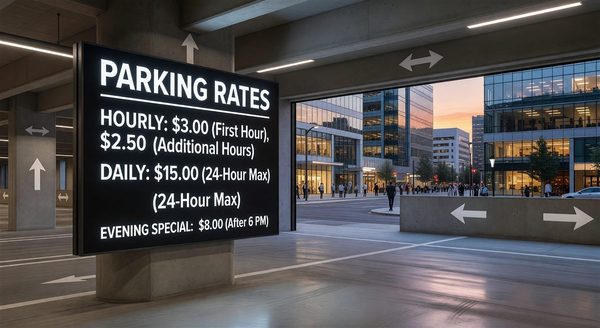
Yield management is the practice of selling the right product to the right customer at the right price and the right time. Airlines built their entire pricing infrastructure around it. Hotels refined it into a discipline. Parking has been slower to adopt it — but the underlying logic applies just as cleanly to a 300-space garage as it does to a 200-room hotel.
The core unit in parking yield management is revenue per available space-hour (RevPAS) — the parking equivalent of RevPAR in hospitality. It’s a deceptively simple metric: total revenue divided by total available space-hours in a given period. But tracking it by time segment, demand pattern, and customer type unlocks a fundamentally different way of thinking about parking pricing.
Why Yield Management Works in Parking
Parking shares three key characteristics with airline seats and hotel rooms that make yield management applicable:
Inventory is perishable. A parking space that goes unoccupied from 9am to 10am on a Tuesday is revenue that cannot be recovered. Unlike physical goods, unsold parking has zero salvage value.
Demand is segmentable and predictable. Commuter demand peaks Monday–Friday, 7–9am. Event demand spikes on game nights and weekends. Short-duration shoppers and diners behave differently from all-day parkers. These patterns are consistent enough to price against with confidence.
Willingness to pay varies by customer segment and booking time. A commuter who needs reliable monthly parking has a different price tolerance than a one-time visitor who decided to drive at the last minute. A parker booking a spot three days in advance for a stadium event behaves differently than someone circling the block looking for the cheapest available space.
These are precisely the conditions under which yield management produces measurable revenue lift — typically 10–25% over flat-rate approaches when implemented systematically.
Yield Management vs. Hotel and Airline Approaches
Understanding where parking converges with and diverges from hospitality and airline yield models is useful for setting expectations.
What translates directly
Time-based demand segmentation. Airlines price by departure time; hotels price by arrival date. Parking operators should price by entry window — with peak, shoulder, and off-peak rates that reflect actual demand curves. A downtown garage that charges the same $4/hour from 7am to 7pm is leaving peak-hour revenue on the table.
Advance purchase discounts. Airlines discount early bookings to secure load factors; hotels offer advance purchase rates for the same reason. Pre-sold parking — through apps, websites, or monthly contracts — gives operators predictable base occupancy and justifies a modest discount relative to walk-up rates.
Capacity controls by segment. Hotels protect a portion of inventory for high-rated walk-in guests rather than selling out entirely to discounted advance purchases. Parking operators should apply the same logic: reserve a percentage of spaces for transient (typically higher-revenue-per-hour) parkers even when monthly permit demand could theoretically fill the lot.
Where parking diverges
Duration uncertainty. An airline knows exactly when a seat will be available again — at destination arrival. Hotels know by checkout time. Parking operators face duration uncertainty for every transient parker. This makes capacity management more complex and is the primary reason dynamic pricing in parking requires either real-time occupancy sensing or conservative buffer management.
Product homogeneity. Airline seats and hotel rooms carry differentiating attributes (class of service, floor, view) that support tiered pricing independent of time. Parking spaces are largely homogeneous — a space is a space. Location within a facility (covered vs. uncovered, proximity to elevator or entrance) offers limited differentiation, and most operators don’t exploit it.
Technology gap. Revenue management systems in hospitality are mature, widely available, and often integrated into property management software. Parking’s equivalent — real-time occupancy data feeding dynamic pricing across all sales channels — is available but not yet standard across the industry. Many operators, particularly independent and smaller regional ones, are working with basic POS data rather than real-time demand feeds.
The Four Levers of Parking Yield Management
1. Demand Segmentation
Start by identifying the distinct customer segments using your facility and their behavioral patterns. For most urban and suburban facilities, the primary segments are:
- Monthly permit holders — committed, price-stable, highest lifetime value, low revenue-per-hour
- Early-bird / commuter transient — consistent daily behavior, moderate price sensitivity, responsive to flat-rate incentives
- Short-duration transient (under 2 hours) — shoppers, appointments, errands; highest revenue per hour; most price-sensitive to small changes
- Long-duration transient — full or most-of-day parkers who are primarily comparing your daily max against alternatives
- Event parkers — infrequent, inelastic demand around specific events; highest willingness to pay
Each segment should be priced and managed independently. A rate structure that optimizes for commuter utilization will almost certainly undercharge for event demand and overcharge for short-duration shoppers.
2. Time-of-Day and Day-of-Week Pricing
This is the most accessible yield management lever and the one most operators under-utilize. The goal is to align pricing with the actual demand curve rather than applying a flat rate across all hours.
A practical structure for a downtown commuter-oriented garage:
| Time Window | Rate Structure |
|---|---|
| 6am–9am (Mon–Fri) | Full hourly rate; no daily max discount |
| 9am–5pm (Mon–Fri) | Standard hourly; daily max applies |
| 5pm–close (Mon–Fri) | Evening flat rate; discounted to drive utilization |
| Saturday | Weekend flat rate, lower than weekday daily max |
| Sunday | Weekend flat rate or reduced hourly |
Facilities near entertainment venues or with significant weekend leisure demand should adjust accordingly — weekend rates at those locations may warrant peak pricing rather than discounts.
3. Advance Booking vs. Walk-Up Pricing
The rate-setting framework establishes your floor and ceiling price points. Yield management then determines how to sequence who gets which price.
Advance reservations (booked through an app or website 24–72 hours ahead) should be priced at a 10–20% discount to the expected walk-up rate for the same time window. This captures price-sensitive demand that might otherwise go to a competitor, while preserving full-rate inventory for walk-up parkers who have demonstrated lower price sensitivity by not booking ahead.
This is directly analogous to hotel advance purchase rates. The advance booker gets certainty; the operator gets revenue assurance and reduced vacancy risk for that space.
4. Capacity Controls and Allocation
Monthly permits should not be allowed to consume 100% of facility capacity. Most operators establish a cap — commonly 80–85% of total spaces committed to monthly contracts — to preserve transient inventory. The logic: transient parkers generate higher hourly revenue and allow for dynamic pricing, while an over-contracted facility leaves no room to capture peak-demand upside.
For event demand specifically, consider a hard allocation: hold back 15–25% of total inventory for day-of transient pricing at event-rate levels, rather than allowing monthly permit holders and advance-purchase parkers to pre-fill the lot at non-event prices.
Implementing Basic Yield Management Without Sophisticated Software
You don’t need a dedicated revenue management system to implement the core principles. Here’s what you can do with standard parking management software and a basic data workflow:
Step 1: Extract and analyze 90 days of transaction data. Most POS and access control systems can export transaction logs. Pull entry time, exit time, duration, and revenue per transaction. Segment by day of week and 2-hour time windows. This gives you your demand baseline.
Step 2: Calculate RevPAS by time segment. For each 2-hour window, divide total revenue by total available space-hours. This identifies where you’re generating strong revenue per unit and where you’re underperforming.
Step 3: Identify your top-performing and worst-performing segments. Typically, the worst-performing segments are late evenings and one day of the weekend. These are your off-peak pricing targets — discount here to drive utilization. Your best-performing segments (often weekday mornings) are where modest rate increases yield revenue gains with minimal occupancy impact.
Step 4: Implement time-based rate changes in your POS. Even basic parking management software supports time-of-day rate tables. Set distinct rates for your identified peak, shoulder, and off-peak windows.
Step 5: Monitor RevPAS monthly, not quarterly. Yield management requires a tighter feedback loop than static rate reviews. Track RevPAS by segment monthly and compare against the prior period. A rate change that boosted peak RevPAS by 8% while eroding off-peak utilization needs to be assessed in total before declaring success.
For operators ready to move beyond manual analysis, there is a growing set of parking-specific revenue management tools — ParkHub, Passport, SpotHero for Business, and others — that can automate demand sensing and pricing recommendations. The dynamic pricing results documented across these platforms consistently show 15–30% RevPAS improvement in the first year for operators transitioning from flat-rate structures.
Setting Realistic Expectations
Yield management is not a pricing magic trick. It doesn’t manufacture demand that isn’t there. It optimizes the capture of revenue from demand that already exists but is being priced suboptimally.
Operators with highly predictable, segmented demand profiles — downtown commuter facilities, airport surface lots, event-venue parking — will see the clearest gains. Operators with highly variable or undifferentiated demand will see more modest improvements until they can build a richer transaction data history to price against.
The investment required is also meaningful. Implementing even a basic yield management program requires 2–4 hours per month of data analysis, willingness to adjust rates on a monthly rather than annual cycle, and buy-in from whoever manages monthly permit customers (who will notice and react to rate structure changes more quickly than transient parkers).
Done consistently, however, the RevPAS gains from yield management compound over time. An operator who lifts RevPAS by 12% in year one through time-of-day pricing and advance purchase segmentation, then adds capacity controls in year two, typically sees cumulative gains that significantly outperform any single round of flat rate increases.
Practical Takeaways
Parking yield management doesn’t require airline-grade revenue systems to produce meaningful results. The core discipline — matching price to demand by segment, time, and booking behavior — is implementable today with standard tools and a structured data practice.
Start here:
- Segment your customers into monthly, transient-peak, transient-off-peak, and event categories
- Calculate RevPAS by time window, not just average occupancy
- Implement time-of-day rate tiers — at minimum, a peak rate, a standard rate, and an evening/off-peak flat rate
- Protect transient inventory by capping monthly permit allocation below 85% of capacity
- Review RevPAS monthly and adjust one variable at a time to build a clean performance feedback loop
The goal isn’t perfect pricing — it’s continuously improving revenue capture from the inventory you already have.