Setting parking rates is one of the highest-leverage decisions a parking operator makes — and one of the most commonly botched. Too many operators rely on gut instinct, match whatever the competitor across the street charges, or leave rates unchanged for years because it feels risky to touch them. The result is either revenue left on the table or occupancy that craters when demand softens.
This guide lays out a structured framework for parking rate setting — one grounded in occupancy data, market context, and demand-based logic rather than guesswork.
The Foundational Principle: Price to Occupancy, Not to Competition
The single most important shift in parking rate strategy is moving from competitive pricing to occupancy-based pricing. Your competitor’s rate tells you almost nothing about what your facility can bear. What does tell you: how full your lot is at different hours and price points.
The industry benchmark most operators work toward is 85% occupancy as the target utilization ceiling. At 85%, you’re capturing nearly all available revenue without triggering the customer frustration that comes from a facility that feels perpetually full. Below 70%, your rates are likely too high for the demand level, or your product isn’t differentiated enough to fill at current prices. Above 90% consistently, you’re underpriced — you’re turning away revenue and creating negative customer experience.
Tracking your parking revenue KPIs — including occupancy by hour, day, and entry type — is the prerequisite for any serious rate-setting exercise.
Step 1: Establish Your Baseline Market Data
Before adjusting a single rate, you need to know what the market looks like around you.
Competitive benchmarking checklist:
- Survey transient rates (hourly, daily max) within a half-mile radius for urban facilities; expand to one mile for suburban
- Note whether competitors offer monthly permits, and at what price points
- Identify the lowest- and highest-priced facilities — you want to understand the full range, not just the median
- Check whether competitors publish rates online (Google, SpotHero, ParkWhiz, direct websites); mystery-shop the remainder
Benchmark ranges by facility type (2020–2021 data):
- Urban structured garages (downtown core): $3–$8/hour; $15–$40 daily max
- Urban surface lots: $2–$5/hour; $10–$25 daily max
- Suburban commercial: $1–$3/hour; $6–$15 daily max
- Airport surface long-term: $8–$18/day
- Event-adjacent facilities: $15–$40 flat event rate
These are ranges, not targets. Where your facility lands within those ranges depends on your location quality, product differentiators (covered vs. surface, security, EV charging), and demand profile.
Step 2: Audit Your Occupancy by Time Segment
Pull at least 60 days of transaction data — 90 days is better — and segment occupancy by:
- Hour of day (6am to midnight minimum)
- Day of week (weekdays vs. weekends behave fundamentally differently)
- Entry type (monthly permit holders vs. transient)
Look for the peaks and valleys. Most facilities have two or three distinct demand profiles within a single day. A downtown commuter lot might hit 95% from 8am–5pm Monday–Friday, then sit at 15% on Saturday afternoon. These are not the same product. Pricing them identically is a mistake.
Calculate your revenue per available space-hour (RevPAS) for each segment. This is the core metric that tells you whether a pricing change actually improved performance or just shifted the same demand to different hours.
Step 3: Define Your Rate Structure
Most facilities should operate with at least three distinct rate tiers:
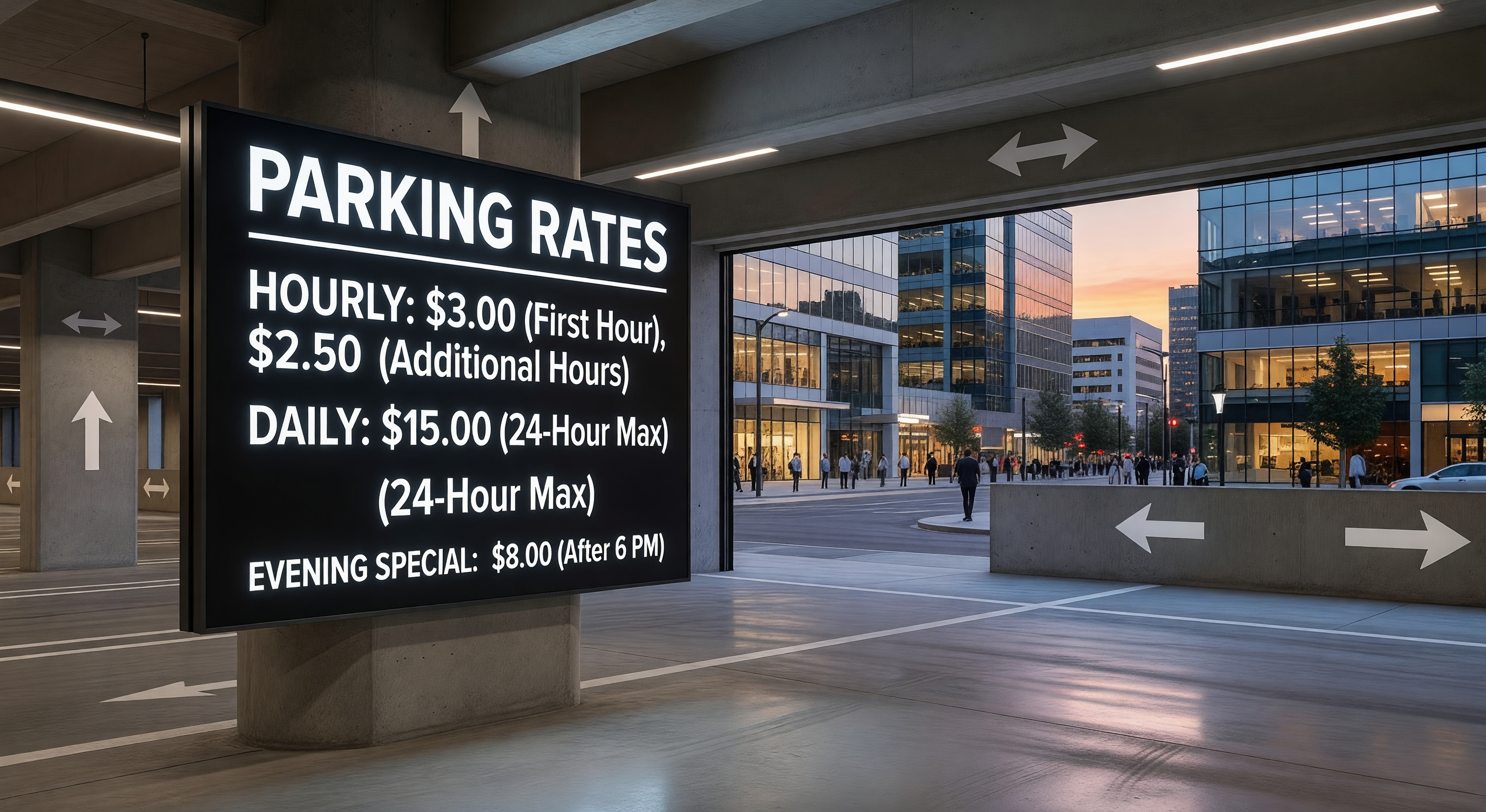
Hourly Rate
Your base transient rate, typically structured in 30-minute or 1-hour increments. Set this to capture short-duration parkers (30 minutes to 2 hours) at a premium per-unit rate. Short stays should always yield more per hour than longer stays — that’s by design.
Daily Maximum
The cap on what a full-day parker pays. Your daily max competes most directly with monthly permit pricing and with other commuter-oriented options in your market. A common target: daily max should be roughly 40–55% of your monthly rate divided by 20 working days. If your monthly is $120, a daily max of $12–$15 is within normal range.
Evening and Weekend Rates
Discounted flat rates for off-peak periods. Evening rates (typically after 5pm or 6pm) and weekend flat rates serve a different use case — entertainment, dining, errands — with a different price sensitivity. Offering a flat $5–$8 evening rate on a facility that otherwise charges $4/hour for the first two hours can meaningfully grow off-peak utilization without cannibalizing peak revenue.
Monthly Permits
Monthly contract parkers are your annuity revenue. They provide predictable baseline occupancy and reduce administrative load. Price monthly permits at a discount to the daily max equivalent, but don’t over-discount. A monthly that’s priced below 15 daily-max equivalents per month is probably leaving revenue on the table.
Step 4: Set Rate Change Timing and Cadence
Rate changes should be:
Scheduled, not reactive. Changing rates in response to a bad week is a mistake. Build a quarterly review cadence: pull occupancy data, compare to your 85% target, and make adjustments based on trend data rather than short-term noise.
Incremental. Large rate jumps — 30% or more — create customer resistance even when the market justifies the increase. Move in steps of 10–20%, then monitor occupancy response over 30–45 days before deciding whether further adjustment is warranted.
Announced when you have regulars. If monthly or contract parkers use your facility, give 30 days’ written notice of any rate increases. Surprise rate hikes are a primary driver of churn among your most reliable customers.
Tied to market events when appropriate. Nearby construction completion, new transit additions, major employer arrivals or departures, and comparable facility closures are all legitimate triggers for a market re-survey and potential rate adjustment outside your standard review cycle.
Step 5: Implement and Monitor
Once rates are set, the work isn’t done. For the first 60 days after any meaningful rate change, track:
- Occupancy by time segment vs. your pre-change baseline
- Revenue per available space-hour vs. baseline
- Transient transaction count (a proxy for price sensitivity — if transactions drop sharply but revenue is flat, you’ve repriced out some marginal parkers without losing revenue; if both drop, you’ve overshot)
- Monthly permit churn rate
Use this data to validate your pricing assumptions or identify segments where further adjustment is needed. A good yield management approach takes this monitoring loop further — using real-time demand signals to adjust rates dynamically rather than on a fixed schedule.
Common Rate-Setting Mistakes
Matching the competitor’s headline rate without understanding their occupancy. Your competitor’s rate reflects their situation — their location, their product, their cost structure. It doesn’t tell you what your facility can bear.
Treating the entire facility as one product. Monthly permits, early-bird specials, transient hourly, and event parking all serve different customer segments with different price tolerances. A single rate for everything is almost always wrong.
Ignoring the daily maximum as a lever. Many operators set their hourly rate thoughtfully but treat the daily max as an afterthought. The daily max is often the most important number on your rate board — it’s what most full-day parkers actually pay.
Raising rates without a demand cushion. If you’re running at 70% occupancy, a rate increase is a risk without a demand driver behind it. Rate increases work when demand is strong and occupancy is near or above your target ceiling. Don’t raise rates to fix a revenue shortfall caused by low occupancy — fix the demand problem first.
Not segmenting off-peak and on-peak rates. A flat rate that works for peak periods is almost always too high for evenings and weekends. Leaving off-peak pricing undifferentiated means leaving utilization — and revenue — on the table.
Changing rates too frequently. Customers (especially monthly parkers) develop expectations. A facility with quarterly rate changes and clear communication retains customers better than one that moves rates unpredictably, even if the end prices are similar.
Practical Takeaways
Rate setting is a continuous process, not a one-time decision. The operators who do it well run quarterly reviews, monitor occupancy by segment, and make incremental adjustments based on data rather than intuition or competitive reflex.
Start with these four anchors:
- Know your occupancy by time segment — this is your pricing signal
- Benchmark your market, but use it as context, not as a target
- Build a rate structure with at least three tiers: hourly, daily max, and off-peak
- Review quarterly, adjust incrementally, and track RevPAS as your primary performance metric
A facility running at 82–88% average occupancy with a differentiated rate structure is a well-priced facility. Everything else is calibration.