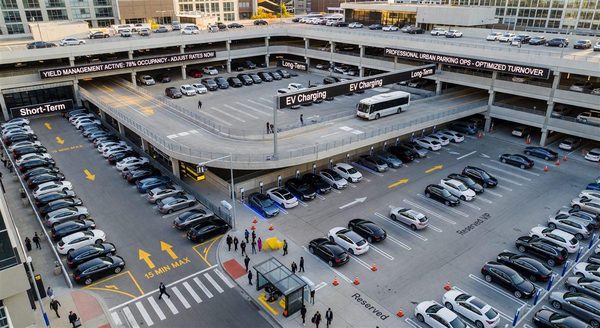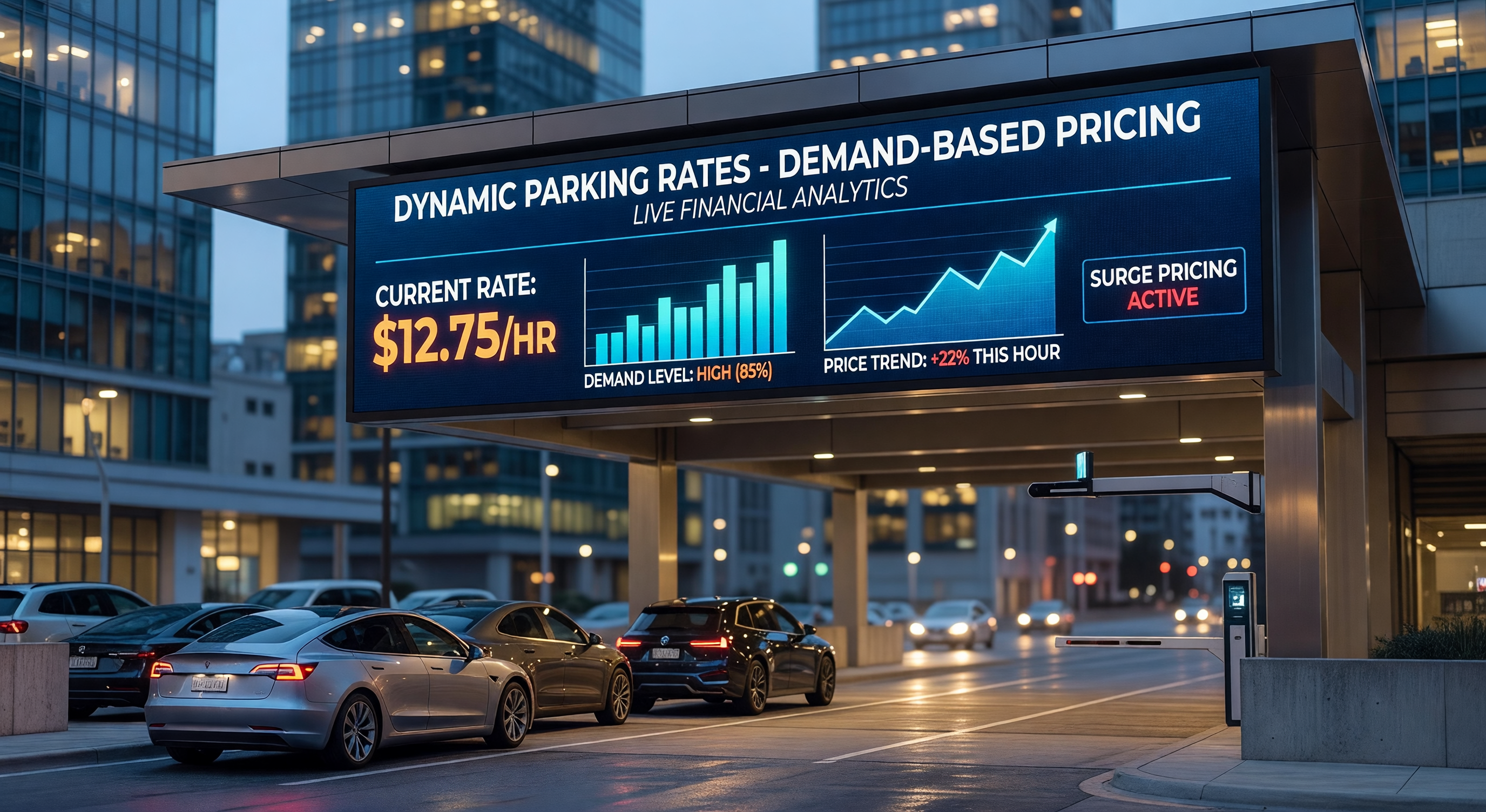
Dynamic pricing has been a fixture in airline revenue management since the 1970s and hotel rooms since the 1980s. Parking took longer to arrive at the concept — and the industry is still sorting out when it works, when it doesn’t, and what the numbers actually look like when you strip away the vendor case studies.
This piece examines the evidence: pilot programs, municipal data, and operator experience with demand-responsive pricing in parking operations.
What Dynamic Pricing Actually Means in Parking
The term gets used loosely. For purposes of this analysis, dynamic pricing in parking means adjusting rates in response to real-time or predictive demand signals — occupancy, time of day, day of week, events, or weather — rather than setting a flat rate and leaving it unchanged for months or years.
That’s different from tiered pricing (offering discounted early-bird rates), surge pricing (a fixed premium during peak windows), or annual rate reviews. Those approaches have value, but they aren’t dynamic in any meaningful sense. True dynamic pricing involves an algorithm or decision rule that changes the posted rate based on conditions.
This distinction matters because the two approaches have very different operational requirements, very different customer experience implications, and very different revenue curves.
What the Data Shows: SFpark and the Municipal Experience
The most-cited real-world dataset on parking dynamic pricing comes from San Francisco’s SFpark pilot, which ran from 2011 to 2013 across roughly 7,000 on-street spaces and 12,250 garage spaces in six pilot areas.
The program adjusted meter rates up or down in $0.25 increments based on occupancy targets — aiming for one or two available spaces per block face, a standard derived from Donald Shoup’s research on circling behavior. Key findings:
Occupancy stabilized. In pilot areas, the percentage of block faces exceeding 80% occupancy (the threshold associated with circling traffic) dropped from 35% to 27%. Average block-face occupancy moved closer to the 60–80% target band.
Average rates fell in most areas. Counterintuitively, the average hourly rate in pilot areas dropped compared to control areas. That’s because many low-demand blocks received rate cuts — demand-responsive pricing works in both directions, and San Francisco found a significant portion of its inventory was overpriced relative to actual demand.
Revenue was mixed. The SFMTA reported overall revenue outcomes that were roughly neutral compared to projections — neither the bonanza nor the disaster that different stakeholders predicted. The revenue gain came primarily from higher utilization in previously underused areas and better capture in high-demand zones during peak windows.
Double-parking declined. A secondary finding, but meaningful for operators thinking about adjacent spillover effects: blocks where parking became available reduced driver frustration behavior.
The SFpark data is the most rigorous publicly available dataset, but it’s a municipal curbside program. Translating those findings to off-street facilities — garages, surface lots — requires adjustments. Private facilities have more control over access, can use license plate recognition (LPR) for better demand data, and don’t face the same equity and political constraints as city programs.
Private Operator Experience
Operator-reported results vary considerably based on asset type. What the evidence suggests across private implementations:
- Event-driven facilities tend to see the strongest revenue impact. A parking structure adjacent to a stadium or arena serving 30+ events per year can capture 20–35% more transient revenue per event period when pricing is demand-responsive versus a flat event rate.
- Daily commuter-dominant facilities see more modest gains. When the occupancy profile is predictable and demand is price-inelastic (commuters who have few alternatives), dynamic pricing adds complexity without proportionate revenue upside.
- Mixed-use urban garages — serving retail, office, and transient parkers — show the most consistent benefit from demand-responsive rates, typically in the 8–15% revenue-per-space range versus flat-rate comparables, per operator-reported data from yield management consultants.
When Dynamic Pricing Works — and When It Backfires
Conditions That Support Success
Demand variance is high. If your occupancy runs between 30% and 95% depending on day, time, and event, there’s genuine pricing opportunity. If it runs between 70% and 85% consistently, the yield improvement from dynamic pricing won’t justify the system investment.
Multiple access points with automated control. Dynamic pricing without gated, automated entry creates a credibility problem — you can post a $12 rate and have no way to enforce it versus your normal $8 rate if your cashier or honor-pay system doesn’t enforce it consistently.
Competitor pricing visibility exists. Dynamic pricing is most effective when parkers have alternative facilities nearby and make real-time decisions. In those markets, price signals actually change behavior. In captive-demand environments (airport overflow, sports venue adjacent), demand elasticity is lower and the revenue gains from dynamic pricing are compressed.
The decision cycle is short. Parking decisions — especially transient — are made within minutes or hours of arrival. Rate changes that happen on a 15-minute or hourly basis align with actual parker decision windows. Rate changes that take days to propagate to signage, apps, and reservation systems undermine the core mechanism.
Where It Fails
Rate changes outpace communication. The most common failure mode in dynamic pricing implementations is posting rates that differ from what parkers see when they arrive — or rates that change between when a parker decides to enter and when they pay. This produces refund requests, complaints, and reputation damage that erode the revenue gains.
Demand is already capacity-constrained. A facility running at 95% during peak periods cannot meaningfully improve utilization via pricing. Raising rates may improve per-space revenue in the short term but displaces demand rather than capturing it.
Too-frequent changes confuse regular users. Operators who have implemented real-time (sub-hourly) price changes in commuter facilities report significant friction — regular users make parking decisions based on habit and don’t check rates daily. When the expected rate is meaningfully wrong on a given day, the customer service cost can exceed the revenue gain.
Pricing changes aren’t reflected at entry. Any gap between the posted rate and the charged rate — whether from outdated signage, app data lag, or reservation system mismatches — is both a revenue problem and a customer experience problem. This is the single most common implementation failure.
Technology Requirements for Real Implementation
Dynamic pricing isn’t a software purchase; it’s a systems integration project. The components required to run a functional demand-responsive program:
Real-Time Occupancy Data
You cannot adjust rates based on demand you can’t measure. This requires either:
- Loop detectors or overhead sensors providing real-time space counts
- LPR entry/exit tracking with confidence rates above 90%
- Transactional entry/exit data from a PARCS system updated in near-real-time
Manual counts do not support true dynamic pricing. A facility doing clipboard occupancy surveys twice a day is doing scheduled pricing at best.
Connected Rate Display
Rate changes must propagate to all customer-facing surfaces simultaneously or near-simultaneously:
- Variable message signs (VMS) at facility entry
- Third-party navigation/parking apps (SpotHero, ParkWhiz, Google Maps parking layer)
- Direct booking or reservation systems
- Any overhead lane-direction indicators in multi-entrance garages
Facilities using static printed rate boards or hand-written signs on easels cannot implement true dynamic pricing without resolving the display problem first.
PARCS Integration
The parking access and revenue control system must accept rate parameter changes — either via API or direct configuration update — without requiring manual cashier intervention. If an attendant has to override or manually enter a rate change at the booth, the process breaks down at scale.
Rate Logic / Decision Engine
This can range from a simple rule set (rate goes to $X when occupancy exceeds Y%) to a machine learning model that incorporates weather, events, competitor rates, and historical patterns. Most operators start with rule-based systems and add sophistication over time.
Answering Common Objections
“Our customers won’t accept unpredictable rates.”
Evidence from hospitality and airlines suggests that customers adapt to dynamic pricing when the logic is transparent and the communication is consistent. The objection is really about execution — customers don’t object to variable rates per se, they object to being surprised by rates they didn’t expect. Solve the communication problem and the acceptance problem mostly solves itself.
“We’ll lose our monthly parkers.”
Monthly parker rates should be separated from transient dynamic pricing. Monthly accounts are typically contractual arrangements with fixed terms — they’re not the target segment for demand-responsive pricing and shouldn’t be exposed to rate fluctuations. A facility can run dynamic transient rates while maintaining stable monthly pricing.
“The investment won’t pay off for our facility size.”
For facilities below roughly 200 spaces or with limited event-driven demand variance, this objection often has merit. The technology overhead — occupancy sensors, PARCS integration, VMS, ongoing system management — has real cost. Facilities where yield management principles suggest low demand elasticity or low variance should model the ROI carefully before committing.
“Our city council/board will never approve it.”
Municipal operators face political constraints that private operators don’t. The SFpark model — framing dynamic pricing as an occupancy management tool rather than a revenue extraction tool, with transparent downward adjustments as well as upward ones — has proven more politically viable than pure surge pricing rhetoric. The framing matters.
Practical Takeaways
Dynamic pricing generates real revenue improvement in the right conditions — typically 8–20% per-space revenue gains for facilities with genuine demand variance, good technology infrastructure, and strong rate communication discipline.
The failures are almost always operational: rate changes that don’t reach the customer, pricing rules applied to demand profiles that don’t warrant them, or systems that can’t enforce the posted rate at entry.
Before committing to a dynamic pricing implementation, operators should audit three things: the actual variance in your occupancy data over the last 12 months, the speed and completeness of your rate communication infrastructure, and your baseline rate-setting methodology using disciplined baseline rate-setting practices. If the occupancy variance isn’t there, or the communication infrastructure can’t support it, the revenue case doesn’t hold.
For facilities that do meet the conditions, demand-responsive pricing is less a question of whether to implement than how to sequence the technology components and align the yield management principles that should underpin the rate logic.
The SFpark finding that average rates fell in most areas is worth sitting with. Dynamic pricing done right isn’t just about charging more during peaks — it’s about charging the right amount across the full occupancy curve. That’s a more sophisticated revenue management posture than most parking operations have historically taken, and it’s where the sustainable gains actually live.