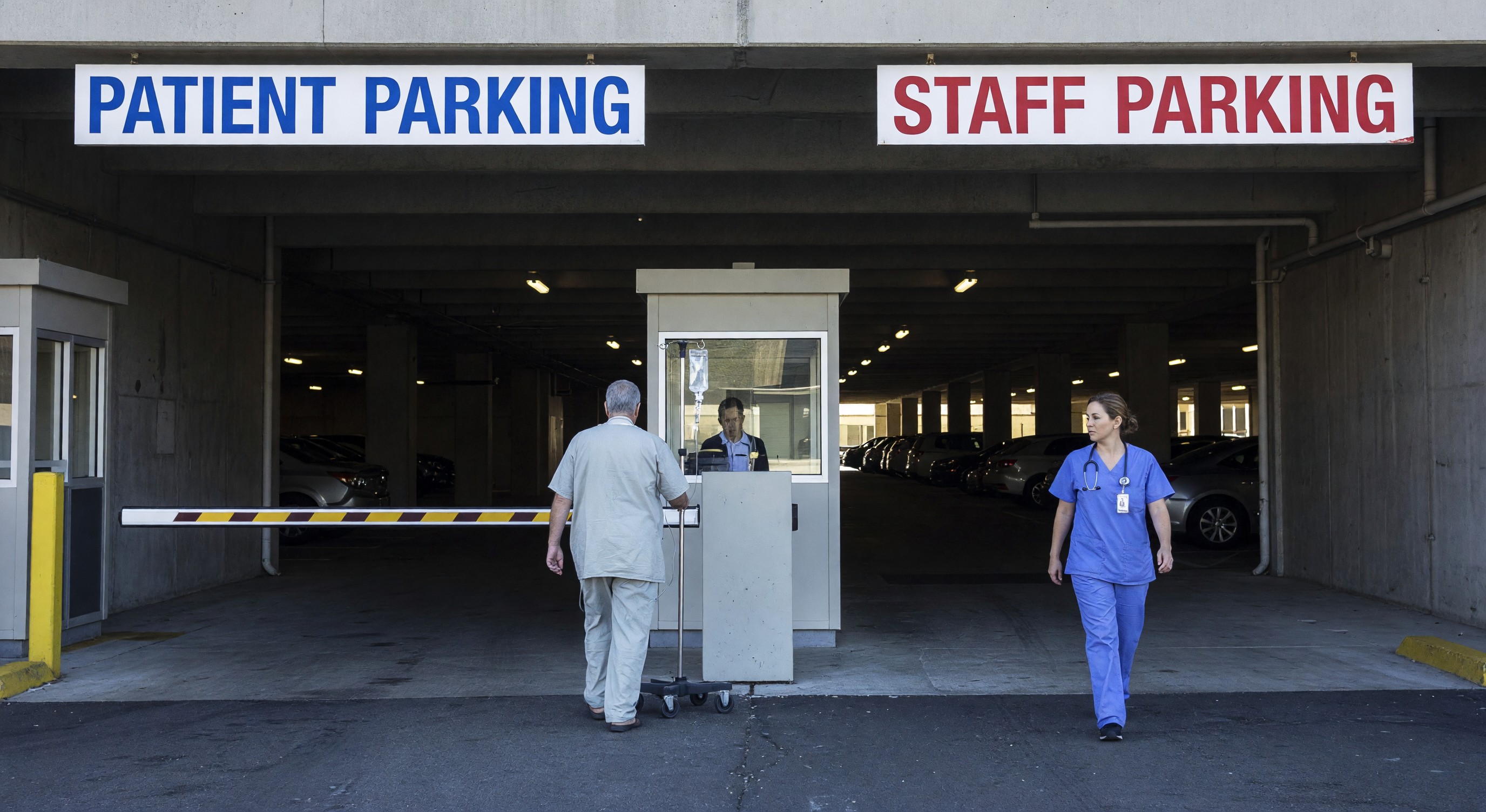
Hospital parking is not like other parking. The people using it are often arriving at the worst moments of their lives — visiting a critically ill family member, managing a chronic condition, presenting for an emergency. The stakes of parking access failure are not inconvenience; they can be a patient missing a critical appointment or a caregiver unable to reach a family member in a crisis. At the same time, hospital parking is a significant revenue source — often $3 million to $10 million annually for major medical centers — and the financial pressure on health systems means that parking revenue cannot be left uncaptured.
Managing this tension is the central challenge of hospital parking strategy. Operators looking to benchmark revenue performance across facility types — including healthcare — will find context in the 2025 parking revenue benchmarks. The facilities that do it well have explicit policies that distinguish between patient and visitor parking, where access is the primary value, and staff parking, where financial capture is more straightforward. They have rate structures that reflect the different elasticity of these user groups. And they have operational designs that reduce friction for the highest-need users while maintaining revenue discipline across the system.
The Patient and Visitor Parking Problem
Patients and visitors at healthcare facilities are captive users — they have no meaningful alternative to the hospital’s parking if they need to access the facility by car. This creates high price inelasticity, which means that raising rates on patient parking does produce revenue without significant volume loss. It also creates a political and reputational exposure that most health systems are unwilling to accept.
The standard response is to establish patient and visitor parking rates at a level that captures meaningful revenue — enough to cover the operating cost of the structure plus a contribution to the system’s capital — without reaching the threshold that generates community relations problems or patient satisfaction complaints. Where exactly that threshold sits varies by market, patient population income distribution, and health system brand positioning.
The practical range for patient-visible daily maximums in hospital parking tends to cluster around $10–$20 in most urban markets, with validation programs providing partial or full validation for financial hardship cases, frequent outpatient visitors, and certain program participants. The validation programs are where hospital parking frequently loses revenue that it could otherwise capture — see the validation program audit discussion below.
Rate Structures for Healthcare Settings
A hospital’s rate structure typically needs to accommodate more user segment complexity than a commercial garage. The main segments and their rate logic:
Emergency and urgent care. Many health systems offer the first 30–60 minutes free in emergency department adjacent parking, recognizing that ER arrivals often cannot plan or budget for parking. The cost of this grace period is real — lost revenue on high-turnover transient parking — but the access mission generally justifies it. Tracking how many transactions actually use the free period versus how many patients were in and out within that window informs whether the grace period can be shortened or whether a lower-price first-hour is a better structure.
Outpatient and frequent visitors. Patients on recurring treatment schedules — chemotherapy, dialysis, physical therapy — make the same parking decision multiple times per week for months or years. For these users, the cumulative cost of transient parking at full rack rate is significant and generates real financial hardship at higher rate levels. Most health systems address this through discounted outpatient permits (monthly-style passes at a per-visit price that recognizes frequency) or validation programs administered through the clinic or treatment department. The financial analysis of these programs should track the actual revenue per space per day from outpatient permit parkers versus the transient rate — many outpatient programs give away more revenue than the retention and mission goals require.
Staff parking. Hospital staff are the segment where financial capture is most defensible. Staff are employed by the institution, are paid wages that include reasonable commuting costs, and generally have more flexibility in transportation choices than acute-care patients. Staff parking programs — typically monthly permit arrangements — can be priced at or near market rate for the geography without the patient access concerns that apply to visitor-facing rates. Healthcare institutions often price staff parking at a significant discount from market as a benefit, which is a legitimate employment decision but should be tracked as a compensation cost rather than treated as if it doesn’t affect revenue.
Physician and provider parking. Physician parking is a politically complex segment at most health systems. Physicians who are independent practitioners (not employed by the system) sometimes receive free or heavily subsidized parking as part of their practice arrangement. The cost of this subsidy should be quantified and reviewed periodically against the physician relationship value — free parking for a high-admissions physician who brings significant revenue to the system is a reasonable economic trade; free parking for every credentialed physician regardless of activity level is often unexamined largesse.
The Self-Park vs. Managed Model Question
Hospital health systems typically operate parking through one of three models: direct self-operation, third-party management contract, or lease arrangement where the parking operator takes revenue risk.
Self-operation keeps the revenue within the health system and allows maximum operational flexibility — the system can set rates, adjust programs, and respond to patient satisfaction feedback without a contractual intermediary. The cost is the management overhead of operating a parking business within a healthcare organization, including PARCS management, PARCS capital investment, cash handling, and specialized parking management expertise that is not a core healthcare competency.
Third-party management contracts bring specialized parking operating expertise and typically reduce the health system’s direct operational overhead. The management company takes a fee — typically a percentage of revenue or a flat monthly fee — and manages the operation. Revenue risk stays with the health system; the manager takes an operating fee. The quality of management contract outcomes varies significantly with the quality of the performance agreement and the health system’s engagement with parking as a managed asset rather than a background function.
Lease arrangements transfer revenue risk and operational responsibility to the parking operator. The health system receives a guaranteed payment (or a minimum guarantee plus participation above a revenue threshold), and the operator takes the revenue upside and manages the facility. This arrangement makes the parking revenue predictable for the health system but may cap participation in upside if the market improves. Healthcare institutions considering lease arrangements should model the financial outcome across a range of market scenarios before committing.
Revenue Technology in Healthcare Parking
Healthcare parking facilities that have invested in PARCS technology — LPR-based frictionless exit, integrated validation management, mobile payment — consistently report both operational efficiency gains and modest revenue improvement from reduced payment friction and improved data.
The healthcare-specific application of PARCS technology worth particular attention is validation program integration. When validation programs are managed through PARCS-integrated systems rather than manual paper stamps, the usage tracking is automatic and precise. The common hospital parking validation audit finding — that paper stamp programs are impossible to reconcile accurately against actual usage — disappears when validation is code-based and PARCS-tracked.
LPR-based frictionless exit is high-value in healthcare settings because it eliminates the payment interaction at exit — often a stressful moment for patients and visitors returning to their cars after a difficult appointment or family situation. The patient experience benefit is distinct from the revenue benefit, but both support the argument for the technology investment.
For more detail on the audit steps relevant to validation programs across any parking operator context, see the validation program audit guide.
Benchmarking Healthcare Parking Revenue
Healthcare parking RevPAS benchmarks vary significantly by market and facility type. Broad ranges based on operator-reported data:
- Urban academic medical center: $150–$400 per space per month
- Suburban community hospital: $60–$180 per space per month
- Specialty clinic facility: $40–$120 per space per month (lower utilization, shorter average stays)
- Children’s hospital: often lower than general hospital benchmarks due to longer stays, validation programs, and community relations constraints on patient-facing pricing
These benchmarks should be contextualized against the operating cost structure of the facility. A parking structure with annual operating costs of $90 per space per month needs to generate at least that in RevPAS to cover direct costs before contributing to capital or the health system’s operating budget.
Frequently Asked Questions
Should hospitals offer free parking to patients?
Full free parking for all patients is operationally expensive — the cost of providing and maintaining structured parking must be covered from somewhere — and is increasingly rare in urban markets. The more defensible model is validated parking for financial hardship cases and frequent outpatient visitors, with moderate market-rate pricing for other patients and visitors. The specific level at which patient parking pricing becomes a community relations issue varies by market and patient population.
What is a reasonable staff parking rate at a hospital?
Staff parking rates at hospitals typically range from $40 to $150 per month in most markets — below market rate for the geography as an employee benefit, but not free. Full free staff parking is a significant compensation cost that should be evaluated as a benefit line item. Health systems that have rationalized staff parking pricing typically move to market-aligned rates with payroll deduction, which simplifies administration and makes the benefit cost transparent.
How should hospitals handle physician parking?
Physician parking arrangements should be reviewed against actual admissions and revenue-generation activity. High-admissions, high-revenue physicians who are critical to the health system’s patient volume represent a legitimate case for preferential parking arrangements. Blanket free parking for all credentialed physicians regardless of activity is a benefit that should be sized and evaluated periodically.
What role should validation programs play in hospital parking?
Validation programs in healthcare parking should be targeted at specific populations — financial hardship patients, frequent outpatient visitors in identified programs — with clear usage criteria and tracking. Broad validation programs that validate any patient who asks or that are distributed through clinical staff without systematic controls are a major source of untracked revenue loss.
How do third-party management contracts typically affect hospital parking revenue?
Outcomes depend heavily on the quality of the performance agreement and the health system’s oversight engagement. Well-structured management contracts with transparent performance metrics, open-book accounting, and appropriate incentive alignment typically maintain or improve revenue outcomes relative to self-operation. Poorly structured contracts or absentee oversight from the health system can result in reduced performance with limited recourse.
Is hospital parking an appropriate asset for a parking concession or long-term lease?
Long-term concessions (15–30 years) for hospital parking have been used by some health systems to monetize parking as an asset — receiving an upfront payment or guaranteed minimum in exchange for revenue and operational control. These transactions make sense when the health system values the certainty of guaranteed parking revenue over the upside of operating a performing asset. The key evaluation is whether the concession price reflects a fair long-term value, given that parking demand at healthcare facilities is more stable than commercial parking.
Further Reading from Authoritative Sources
- International Parking and Mobility Institute — Healthcare Parking Resources — IPMI publishes healthcare-specific parking management resources, including data from member facilities on revenue benchmarks, validation program structures, and operational models for hospital parking environments.
- American Hospital Association — Facilities and Operations Resources — AHA’s operational resources for hospital administrators include financial performance benchmarking and facility management guidance relevant to understanding how parking fits within healthcare facility financial management.