Airport parking occupies a distinct position in the parking industry. For benchmarks that contextualize airport performance against other facility types, see the 2025 parking revenue benchmarks: captive demand at the highest price inelasticity end of the spectrum, significant product differentiation within a single facility portfolio, and a competitive dynamic shaped by both on-airport and off-airport operators who have very different cost structures and customer acquisition approaches.
The fundamentals of airport parking revenue — high transient rates, broad price ranges across product tiers, minimal monthly permit revenue, and direct competition with ride-hail and remote parking services — create revenue management challenges that differ substantially from the office-park commuter garage or the urban mixed-use structure.
The Airport Parking Product Portfolio
Unlike most parking types where the product is essentially homogeneous (a space is a space), airport parking is defined by product differentiation. A major commercial airport typically offers multiple distinct parking products at significantly different price points:
Hourly/Cell phone lots: Short-duration parking for passenger pickup, typically free or very low-cost, generating minimal direct revenue but important for traffic management and traveler experience.
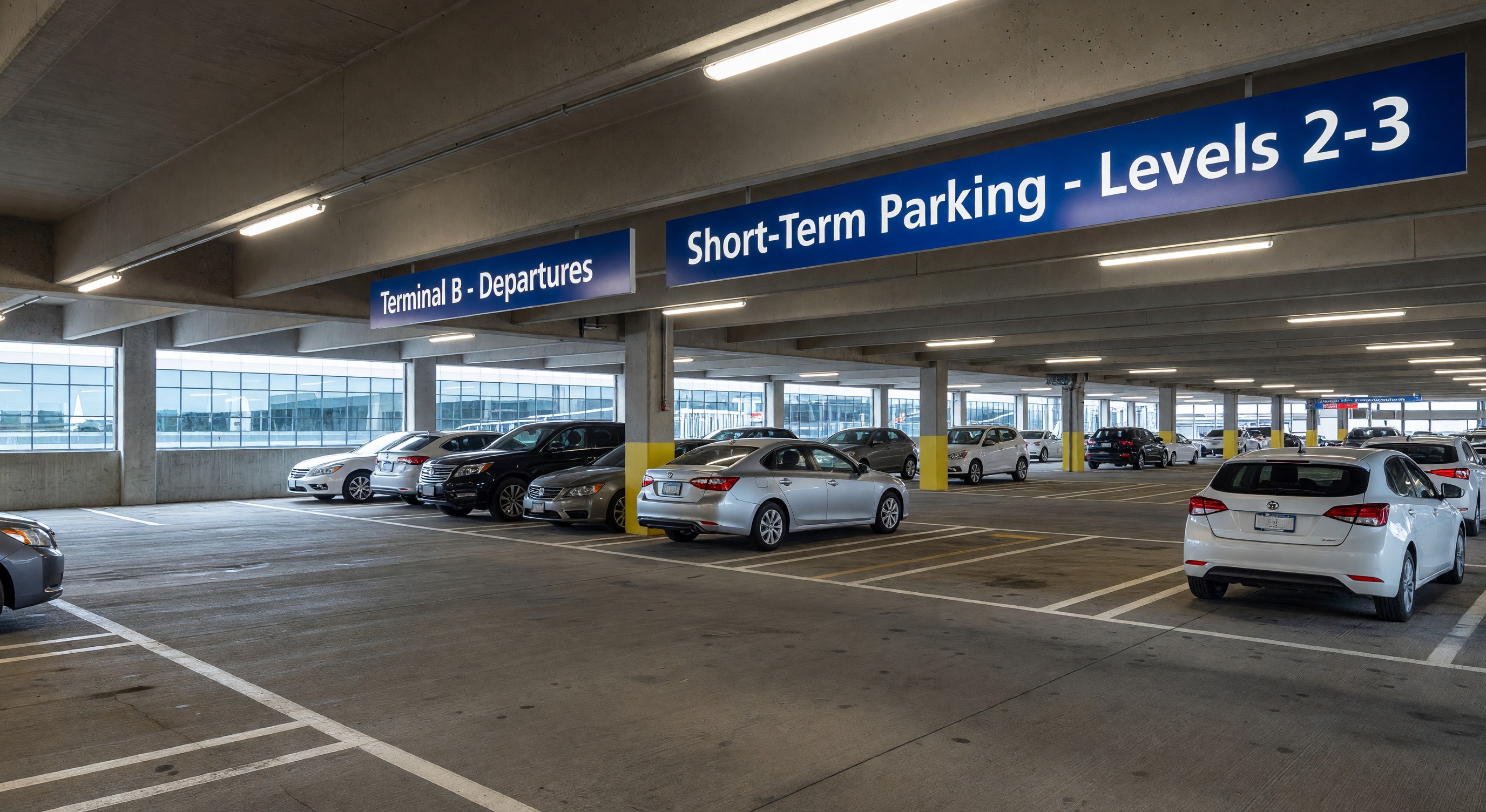
Short-term surface parking: Closest to the terminal, highest daily rates, designed for business travelers and drop-offs who prioritize convenience over cost. Daily rates in major airports range from $25–$60 depending on market.
Long-term surface lots: Further from the terminal, typically shuttle-served, priced for extended-duration travelers. Daily rates typically 40–60% of short-term pricing in the same market.
Covered/garage long-term: Premium long-term product with weather protection and security, priced above surface long-term but below short-term. A meaningful segment of travelers will pay the premium for covered storage.
Economy/remote lots: Most price-competitive product, often 1–2 miles from the terminal with frequent shuttle service. Primary competition for off-airport operators.
Valet parking: High-service product, typically priced 30–60% above short-term surface rates, targeting high-value travelers, business class passengers, and loyalty program members.
Monthly/per-trip permit programs: Employee and commuter permit programs, typically for airport workers, airline employees, and frequent travelers. A smaller revenue component than transient at most airports.
The revenue optimization question at airport facilities is not just rate-setting within a product category — it is allocating capacity across product categories and pricing each category to maximize total portfolio revenue.
Pricing Strategy for Each Product Tier
Airport parking pricing differs from commercial parking in that demand curves are relatively predictable based on flight schedules, seasonal travel patterns, and day-of-week effects that are consistent and foreseeable.
Short-term parking pricing: Customers parking in short-term typically have a specific flight to catch, are willing to pay a premium for proximity, and have low price sensitivity relative to the inconvenience of a cheaper alternative that requires more time. Short-term pricing should be set at the upper end of the market for the category — losing price-sensitive customers to economy lots is often revenue-positive if short-term demand at peak rates is strong.
Economy lot pricing and competitiveness: Economy/remote lots compete directly with off-airport operators, which means pricing here needs to be responsive to competitive dynamics in the market. If the major off-airport operator adjacent to the airport charges $8/day, setting the economy lot at $10–$12/day with a reputation advantage and loyalty program may be sustainable. Setting it at $15/day cedes most price-sensitive travelers.
Advance reservation pricing: Airport parking benefits significantly from advance reservation — both for revenue management (allowing demand-based pricing adjustments as departure dates approach) and for utilization optimization (reducing the uncertainty of day-of-departure demand). Well-designed advance reservation programs with dynamic pricing can improve economy lot and covered long-term revenue by 12–18% relative to flat-rate, first-come-first-served operations.
Event and holiday surge management: Airport parking demand spikes predictably around major holidays — Thanksgiving, Christmas, Memorial Day, July 4th — and during major regional events. Rate management during these periods, using advance reservation pricing that increases as peak periods fill, is one of the clearest revenue optimization opportunities in airport parking.
The Dynamic Pricing Opportunity in Airport Parking
Airport parking is structurally well-suited for demand-responsive pricing because the demand drivers are knowable in advance. Flight schedules are public. Historical demand patterns by date and holiday proximity are available from PARCS records. Weather forecasts inform expected demand variance. The reservation system provides advance purchase data that allows real-time demand assessment before departure day.
Operators who implement dynamic pricing on advance reservations — setting rates that increase as inventory fills and as departure dates approach — see consistent revenue improvements. The mechanism works because:
- Early bookers are price-sensitive travelers who respond to lower prices available weeks out
- Late-booking travelers (1–3 days before departure) are typically less price-sensitive and will pay higher rates if inventory shows scarcity
- Scarcity messaging (60% of spaces reserved) drives conversion from price-sensitive late bookers who fear unavailability
The challenge in airport parking dynamic pricing is rate consistency for travelers who don’t book in advance. If an economy lot is $10/day via advance reservation and $18/day for walk-up arrival, travelers who are surprised by the walk-up rate generate complaints. Rate ladder transparency — showing the advance booking rate and the walk-up rate as separate products — reduces surprise without eliminating the yield management benefit.
The Off-Airport Competition Dynamic
Off-airport parking operators have a fundamentally different cost structure than on-airport operators. They typically occupy lower-cost land (though this varies by airport geography), have no airport concession fees or revenue-share obligations to the airport authority, and may have lower operating cost per space. They compete primarily on price, with a convenience discount for the additional shuttle ride.
The off-airport market in major airport markets is competitive and well-established. Companies like The Parking Spot, LAZ Parking, and regional operators have built significant positions in markets where off-airport land is available. In constrained urban airport markets — LaGuardia, Reagan National — off-airport operations are more limited by geography.
For on-airport operators, the off-airport competitive response has several dimensions:
Service differentiation: Reliability, shuttle frequency, security, and traveler experience at on-airport facilities are generally superior to off-airport competitors. Emphasizing these differences — faster shuttle, covered walkways, TSA PreCheck benefits, loyalty points — justifies a price premium.
Price matching at the economy level: Setting economy product prices close to off-airport pricing — even at a modest premium — reduces the percentage of travelers who choose off-airport primarily on price. The marginal cost of matching on price for the economy product is low; the revenue retained from travelers who would otherwise leave for off-airport operators is meaningful.
Loyalty and pre-pay programs: Frequent travelers who pre-enroll in a loyalty or subscription program reduce their propensity to comparison-shop on each trip. Airport parking loyalty programs — modeled on airline loyalty in offering status tiers, upgrade benefits, and rate certainty — have shown meaningful retention improvement in markets where they’ve been implemented.
Monthly Revenue as a Percentage of Total at Airports
Unlike commercial parking where monthly permits represent 40–70% of revenue in commuter markets, airport parking generates a much smaller monthly revenue component. The primary reasons:
- Most airport-area employees parking at or near the airport use employee permit programs through their employer (airlines, concessionaires, airport authority employees) that are separately managed and often heavily subsidized
- Airport travelers are predominantly transient — they don’t park weekly, they park for the duration of a trip
- Frequent business travelers who fly 100+ times per year often use frequent parker programs that function like monthly permits in commitment but not in daily presence
Monthly permit programs at airports — to the extent they exist — target employees and very frequent regional travelers. The revenue significance is small relative to transient.
Revenue Per Space Benchmarks for Airport Parking
Airport parking RevPAS is among the highest in the industry, reflecting the combination of high transient rates, high utilization, and multi-product portfolios. Broad benchmark ranges:
- On-airport short-term parking: $18,000–$30,000+ per space per year in major markets
- On-airport economy lots: $4,000–$10,000 per space per year
- On-airport structured long-term: $8,000–$15,000 per space per year
- Off-airport economy: $2,500–$6,000 per space per year
Portfolio RevPAS for a major airport (blended across all products) typically ranges from $6,000 to $14,000 per space per year. The range reflects both market size and product mix allocation decisions — airports that have expanded economy capacity relative to short-term have lower blended RevPAS.
Frequently Asked Questions
How does airport parking pricing differ from commercial parking?
Airport parking serves captive demand from travelers who have no realistic alternative to car-based access at many airports, creating higher price inelasticity than commercial parking. It has a multi-product portfolio (short-term, long-term, covered, economy, valet) across a wide price range, and it benefits from predictable demand patterns based on flight schedules and seasonal travel cycles that support advance reservation and dynamic pricing.
What is the impact of ride-hail on airport parking revenue?
Ride-hail services (Uber, Lyft) have taken market share from airport parking, particularly in shorter-trip segments where ride-hail economics are more favorable. The impact varies by market — in cities with low traffic and short distances from residential areas, ride-hail is a strong substitute. In markets with high airport access costs via ride-hail (congested metros with long rides), parking remains the more economical choice for trips above 2–3 days.
Can on-airport parking operators match off-airport prices?
On-airport operators typically have higher costs — land cost (or revenue-share obligations to the airport authority), brand standards, and higher service expectations — that prevent them from matching off-airport prices across all product categories. The competitive strategy is to price economy products within a tolerable premium of off-airport while differentiating on service, reliability, and loyalty program benefits.
How effective are advance reservation programs for airport parking revenue?
Well-implemented advance reservation programs with dynamic pricing consistently improve revenue. The mechanism — early price advantage for advance bookers, higher rates as inventory fills and departure dates approach — captures price-sensitive early demand and higher-margin late demand. Revenue improvements of 12–18% versus flat-rate walk-up operations have been documented in well-run programs.
What should airport parking operators monitor as leading indicators?
Weekly advance reservation pace (how many reservations are booked for the next 2–4 weeks compared to historical pace), upcoming holiday and event periods’ reservation fill rates, and competitive rate positioning from off-airport operators. These leading indicators allow proactive rate management before departure periods rather than reactive rate adjustments that can’t capture already-booked demand.
What is the role of parking in airport concession revenue?
For airport authorities that operate parking as a public function (rather than through private lease), parking revenue is often the single largest non-aeronautical revenue source, funding airport operations and capital. In many major commercial airports, parking generates 20–35% of total non-aeronautical revenue. This financial significance is why airports invest heavily in parking capacity and pricing management.
Further Reading from Authoritative Sources
- Federal Highway Administration — Airport Parking Operations and Revenue — FHWA’s transportation research resources include analyses of airport ground transportation, parking demand modeling, and the relationship between parking revenue and airport financial sustainability.
- Transportation Research Board — Airport Cooperative Research Program Reports — the Airport Cooperative Research Program produces operator-focused guidance on airport parking management, pricing strategy, and competitive dynamics, with reports specifically addressing revenue optimization in the airport parking context.