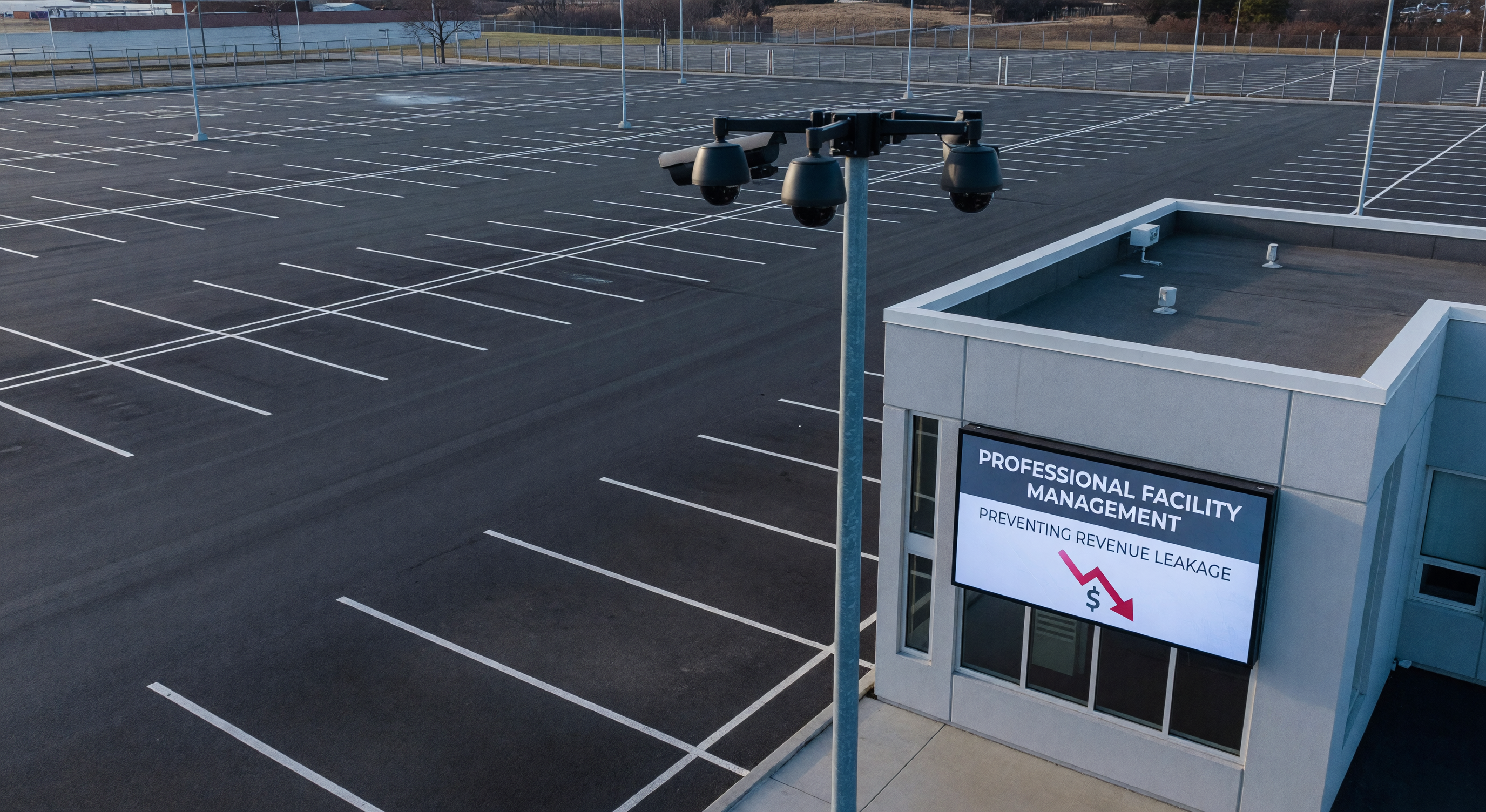
Most parking operations that believe they have a revenue problem actually have a leakage problem. The demand is there. The transactions are happening. The money isn’t reaching the P&L.
Revenue leakage in parking is the gap between what the operation should have collected and what it actually did — encompassing equipment failures, human theft, process gaps, and system errors. Industry estimates suggest that uncontrolled leakage runs between 5% and 15% of gross transient revenue in facilities without strong audit programs. In operations with weak controls, those numbers are higher.
This is a solvable problem. But solving it requires knowing where the money actually goes.
Defining Revenue Leakage
Leakage is typically divided into two categories, though they often overlap in practice:
Unintentional loss includes equipment failures, billing errors, rate misconfiguration, validation system errors, and transaction gaps created by software or integration problems. Nobody stole the money — it just wasn’t collected.
Intentional loss includes cashier theft, attendant collusion, ticket fraud, validation abuse by merchants or employees, and organized gate exploitation. Somebody specifically took the money.
The distinction matters for prevention strategy. Unintentional loss is addressed primarily through systems and configuration audits. Intentional loss requires controls designed to detect and deter people who are actively looking for gaps.
In most parking operations, unintentional loss is larger in absolute terms — but intentional loss tends to have the highest per-incident impact and the longest duration before detection.
The Major Leakage Categories
Gate Failures and Tailgating
Gate arm equipment fails. Sensors miscalibrate. Anti-passback systems have gaps. When gates fail open, whether from a sensor malfunction, a power interruption, or a deliberate reset, the facility collects nothing for entries during that window.
Tailgating — two vehicles entering on a single transaction — is the most common form of equipment-related leakage in gated facilities. Studies of parking operations using LPR cross-checks against gate transaction counts have found that tailgating alone can represent 3–8% of transient revenue in ungated or loosely gated facilities. In facilities with older gate equipment and no overhead sensors, the rate is higher.
The challenge is detection. A tailgate event leaves no transaction record — it appears as an absence of revenue, not a visible error. Without entry count comparison against transaction count, it’s invisible in standard reporting.
Ticket Spoofing and Fraud
Pay-on-foot systems that accept lost ticket rates are common targets for ticket fraud. A parker entering on a short-term ticket, then claiming a lost ticket to pay a flat lost-ticket fee rather than the accrued time-based rate, is a well-documented exploit in facilities where the lost-ticket rate is lower than the maximum daily rate.
More sophisticated ticket fraud involves obtaining or manufacturing old tickets — from a prior day, a different facility, or with a manipulated validation — and presenting them as current. Facilities with aging PARCS equipment that lacks sequence number verification or timestamp validation are particularly vulnerable.
In facilities with meaningful walk-up transient volume, ticket fraud can represent 2–5% of transient revenue if the lost-ticket rate is not calibrated correctly and transaction verification is weak.
Cashier and Attendant Theft
Staffed operations introduce a category of leakage that automated facilities largely eliminate: human handling of cash and ticket transactions.
Classic cashier theft patterns include:
- Transaction suppression: Collecting cash from a parker but not entering the transaction, keeping the cash rather than recording the sale
- Voiding legitimate transactions: Processing a valid payment, then voiding the transaction in the system after the parker leaves, retaining the cash
- Short-changing change: Collecting the full payment but returning less change than owed
- Credential sharing: Using a supervisor or manager credential to apply discounts or validations not authorized for the cashier’s role
Industry loss prevention consultants estimate that active cashier theft in unmonitored staffed parking lanes accounts for 3–10% of cash revenue per affected employee. The range is wide because detection rates vary dramatically — operations with daily reconciliation and camera coverage detect and terminate theft earlier, reducing the cumulative loss per incident.
Validation Abuse
Merchant validation programs are a significant and frequently underestimated leakage source. The mechanics are straightforward: merchants receive validation credits to offer customers free or discounted parking. Abuse occurs when:
- Employees use validations for personal parking or share them with friends
- Merchants validate for customers who did not actually patronize their business (as a customer service gesture or under social pressure)
- Validation instruments (stamps, codes, paper tickets) are not adequately secured and are stolen or shared
- Digital validation codes are not rotated and spread beyond intended recipients
Facilities that have audited their validation programs against POS data from participating merchants — comparing validations issued against transaction records — routinely find error rates of 15–30% in validation volume. That doesn’t mean 15–30% of validations are fraudulent, but it means that many validations are issued for transactions that either didn’t happen or can’t be verified.
In facilities where validations represent a significant share of total transactions, validation leakage can be the largest single revenue gap.
Monthly Account Billing Gaps
Monthly parkers represent recurring, predictable revenue — but monthly account management creates its own leakage category.
Common monthly account leakage sources:
- Credential over-issuance: Issuing multiple access credentials (transponders, keycards, or access codes) per account, with extras used by unauthorized vehicles
- Continued access after cancellation: Accounts that have cancelled or lapsed but where access credentials have not been deactivated, allowing continued facility use
- Rate-tier misassignment: Monthly accounts enrolled at a lower rate tier (nights/weekends only, for example) but using the facility during unrestricted hours
- Expired rate agreements: Long-term monthly accounts continuing to be billed at rates that were set years ago, below current market rate, without any review trigger
Monthly account leakage tends to be invisible in transient revenue reporting because it doesn’t appear as a transaction gap — it appears as steady, apparently normal recurring revenue. The loss is only visible when monthly account utilization is audited against credential issuance, access records, and current rate schedules.
Detection Methods
Transaction Audit Trails
A complete audit trail links every entry event to a transaction — either a paid exit, a validated exit, a monthly credential exit, or a recorded exception (lost ticket, grace period, forced open). Facilities where the entry count and the transaction count diverge, absent documented exceptions, have a gap that needs explanation.
Most modern PARCS systems generate entry and exit log data. The audit question is whether that data is being reviewed — daily, weekly, or at any regular interval — or simply stored and ignored.
Revenue Variance Reports
Revenue variance compares actual collected revenue against expected revenue based on utilization and rate schedules. If a facility running 500 transient transactions at an average rate of $12 should collect approximately $6,000 in a shift, and actual receipts are $5,100, the $900 gap is the variance. Some variance is normal (rate mix, genuine discounts, errors). Consistent variance in a specific lane, shift, or cashier assignment is a signal.
Shift-level and employee-level variance reporting is the most effective tool for identifying cashier theft. It creates accountability at the individual level and makes suppressed transactions visible as a consistent shortfall pattern.
LPR Cross-Checks
License plate recognition, when integrated with entry/exit transaction records, enables the most powerful leakage detection available to parking operations: cross-referencing vehicles observed entering with vehicles that have corresponding paid transactions.
An LPR system that captures entry plates can be compared against the exit transaction database. Vehicles in the entry log with no corresponding transaction record — filtered for known credential holders — represent potential tailgaters, failed transactions, or system gaps. Facilities using this approach typically discover 3–8% of entries with no associated transaction, which then requires investigation.
LPR cross-checks are also effective for monthly account auditing: credential holders accessing the facility at unauthorized times show up as plate-matches to monthly accounts accessing during hour ranges not covered by their rate tier.
Prevention Framework
Technology Controls
- Gate sensors and anti-tailgate equipment: Loop detectors, overhead sensors, or treadle sensors that trigger an alarm or gate hold on vehicle following should be treated as standard infrastructure, not optional upgrades
- Sequence-number validated tickets: Tickets with sequential serial numbers and timestamp encryption prevent old-ticket fraud and make ticket manipulation detectable
- Real-time revenue monitoring: PARCS dashboards that surface transaction-count-to-entry-count ratios in real time, rather than requiring end-of-day reconciliation, catch problems within the shift rather than after the fact
- Validation management systems: Digital validation platforms with per-account issuance limits, usage logs, and merchant portal access replace paper stamps and static codes that cannot be audited
- Automated access deactivation: Monthly account management systems should automatically flag credentials for deactivation review upon account status change, rather than relying on manual deactivation requests
Process Controls
Technology controls fail when process controls don’t support them. The most important process-layer controls:
- Shift-end cash reconciliation: Cash drawers counted, signed, and reconciled against system transaction totals at the end of every shift, with discrepancies documented and investigated at a threshold (typically $20–$50 or more)
- Segregation of duties in validation issuance: The person issuing validation credentials should not be the same person auditing their use
- Monthly account access audits: At minimum quarterly review of credential issuance versus active accounts, deactivating orphaned or excess credentials
- Lost-ticket fee calibration: Lost-ticket flat rates should be set at or above the maximum daily rate, not below it — a lost-ticket rate lower than the daily max is an incentive for fraud
Audit Cadence
The daily reconciliation process is the foundation. Daily cash reconciliation, transaction count verification, and validation usage review catch problems within one shift’s window — limiting the cumulative loss from any single leak source.
Beyond daily reconciliation, a structured audit calendar should include:
- Weekly: Lane-level and cashier-level revenue variance review, gate equipment inspection logs
- Monthly: Validation program usage vs. merchant POS cross-check, monthly account credential audit
- Quarterly: Full internal audit controls pass — rate schedule verification, access system review, transaction log analysis, mystery shopping
Mystery shopping — sending an auditor through the facility as a standard transient parker — remains one of the most effective tools for detecting cashier theft and process gaps, and it is chronically underused in the parking industry.
Practical Takeaways
Revenue leakage in parking is not primarily a technology problem — it’s a measurement and accountability problem. Facilities that measure entry-to-transaction reconciliation daily, audit validation programs monthly, and run cashier-level variance reporting have dramatically lower leakage rates than facilities running the same equipment with no structured review.
Start with measurement. Pull six months of entry counts versus transaction counts. Run shift-level revenue variance by employee. Pull your validation usage logs and compare against any merchant POS data you can access. The gaps will tell you where to focus the controls.
Most facilities discover that two or three leakage sources account for the majority of the gap. Fix those first. A 5% reduction in leakage on a $1 million gross revenue facility is $50,000 in recovered revenue — with no additional marketing spend, no rate increases, and no new parkers required. It’s already your money.
For operations without formal audit programs, the sequence is: establish a daily reconciliation process, build the variance reporting, then layer in the comprehensive revenue audit steps needed to catch the leakage categories that daily reconciliation doesn’t surface. Validation programs specifically — one of the highest-dollar leakage sources — are covered in detail in the validation program audit guide. The investment in audit infrastructure reliably delivers positive ROI within the first quarter.