The vendor claims for AI-powered parking pricing tools range from vague (“optimize revenue”) to specific (“increase NOI by 30%”). Neither version tells operators what they actually need to know: under what conditions does the technology produce measurable revenue lift, and what does the data from real deployments look like?
The market has matured enough that there are now multiple years of operational data from scaled deployments. The picture is more useful — and more qualified — than the sales literature suggests.
What the Revenue Lift Data Shows
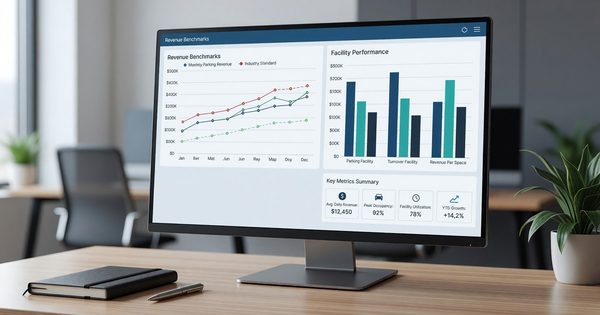
The most widely cited figure in AI parking pricing literature is a 15–30% revenue increase relative to baseline. This range appears across multiple platform reports and industry analyses. The problem with citing it without context is that the figure means different things depending on what’s in the baseline and how the lift is measured.
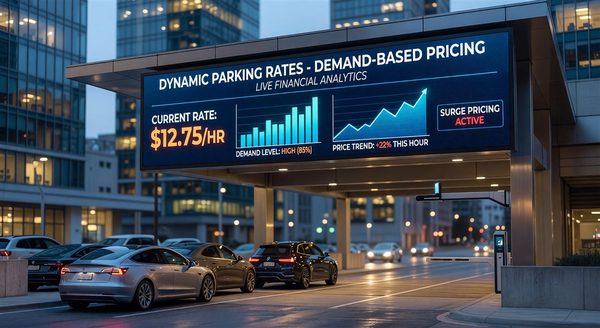
For facilities that were running static rate cards with no dynamic adjustment — a flat daily rate set once per year — even a basic rules-based pricing engine that adjusts rates based on occupancy thresholds can produce meaningful revenue lift. The 15% weekly revenue improvement figure cited in dynamic pricing research applies broadly to demand-responsive pricing, not specifically to AI-driven systems. Moving from no dynamic pricing to any form of demand-responsive pricing captures most of the available gain.
The incremental value of AI-specific tools — machine learning models rather than rules-based engines — is harder to isolate from published data. The clearest evidence comes from hotel parking, where Ocra’s revenue-managed cohort generated $28 million in incremental revenue across 118 assets in 2025 ($237,000 per property on average), and from airport parking, where demand-responsive pricing is now standard. The airport category is instructive: 16% of airports currently use AI and machine learning for pricing decisions, with another 51% planning adoption, per industry survey data. Airport operators are the most analytically sophisticated segment of the parking industry, and their convergence on AI-based yield management reflects genuine confidence in the revenue outcomes.
For off-airport facilities — urban garages, surface lots, event-adjacent facilities — the revenue data is less systematic. AirGarage, a full-stack parking management platform, reports 20–30% net operating income improvement for properties transitioning to its managed pricing approach. This figure blends pricing improvement with operational improvements (enforcement, digital payment penetration, cost reduction) and can’t be cleanly attributed to the pricing algorithm alone.
What AI Pricing Tools Actually Do
Stripping away marketing language, AI pricing tools in parking do two things that rules-based systems don’t do as well:
Multi-variable demand modeling. A rules-based engine adjusts rates when occupancy crosses a threshold. An ML-based system processes occupancy alongside historical demand patterns, local event calendars, competitor pricing, day-of-week, weather, and other signals simultaneously — and learns from how parkers respond to rate changes over time. For facilities with genuinely complex demand environments (airport lots, convention center adjacent, dense urban cores with variable office occupancy), this additional modeling capacity produces better rate predictions than rules can approximate.
Continuous learning and recalibration. A rules-based system requires manual intervention to update. An ML system recalibrates its model as new data arrives, adjusting to seasonality changes, new competitors, or shifts in parker behavior without requiring the operator to diagnose the change and reprogram the rules. This is most valuable in volatile demand environments.
For facilities with simple demand structures — a commuter lot with predictable occupancy patterns, low event influence, and stable competition — the marginal value of ML-based pricing over well-designed rules is smaller. The technology investment may not pencil out.
Where the Tools Fall Short
The gap between published revenue lift figures and real-world outcomes at specific facilities often comes down to data quality and distribution coverage.
Data quality constraints. AI pricing requires real-time occupancy data, transaction data by rate type, and ideally competitor pricing signals. Facilities without reliable occupancy sensing — running manual counts or inferring occupancy from payment transactions — are feeding incomplete data into a system designed to optimize on accurate inputs. The pricing recommendations produced are correspondingly less reliable.
Distribution gaps. Rate changes generated by an AI pricing engine only produce revenue when those rates reach parkers before they make their parking decision. A system that updates rates in the backend but doesn’t propagate those rates to booking apps, navigation platforms, and digital signage in near-real-time isn’t functioning as a dynamic pricing system — it’s an internal calculation that doesn’t affect parker behavior.
Cannibalization of monthly revenue. Several operators report that aggressive transient rate optimization, particularly during peak events, creates friction with monthly parker retention. Monthly permit holders who observe significantly higher transient rates during events sometimes question their permit value proposition. This is a real but manageable risk — the standard solution is to keep monthly rates on a separate contract structure that isn’t exposed to transient pricing fluctuations.
Implementation complexity vs. staff capacity. Parkify, one of the parking-specific AI pricing platforms, estimates that properties using its technology reclaim 10–15 hours per week of administrative time on parking rate management. This suggests the manual workload of running AI-augmented pricing is non-trivial — operators need staff capacity to monitor recommendations, approve exceptions, and manage distribution channel updates.
Realistic Expectations by Facility Type
Based on the available data, a realistic framework for expected revenue lift from AI pricing tools by facility category:
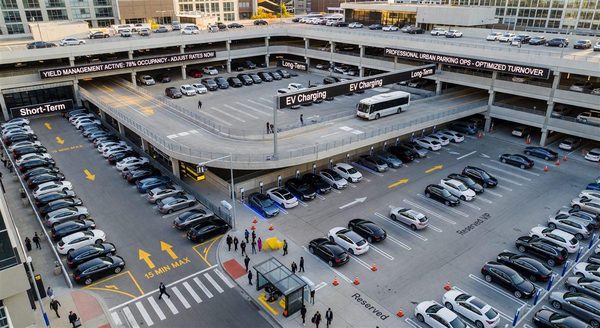
Airport parking: Strongest case. High transaction volume, complex demand (flight schedules, airline changes, seasonal travel patterns), established pre-booking behavior, and willingness-to-pay variance justify the investment. Airport operators are already adopting AI pricing at scale.
Event-dominant facilities (stadiums, arenas): Strong case for event-day pricing; weaker case for non-event periods. The event-day revenue concentration means pricing accuracy on peak days has outsized impact. AI tools that integrate with event calendars and historical per-event demand data produce meaningful uplift versus flat event rates.
Urban garages with mixed demand: Moderate case. The value depends on demand complexity. Facilities with clear demand cycles, multiple parker segments, and competitive alternatives for transient parkers benefit from multi-variable optimization. Facilities with captive demand (limited alternatives, price-inelastic parkers) see less lift.
Commuter-focused suburban lots: Weakest case. Demand is predictable and relatively price-inelastic. Monthly permits, once established, convert at rates that don’t respond strongly to transient dynamic pricing. Basic yield management through periodic rate reviews typically captures most of the available revenue optimization without the overhead of a full AI pricing stack.
The technology works. The question operators should be asking isn’t whether AI pricing produces revenue lift in theory — it does — but whether the demand environment of their specific facility generates the complexity that separates ML-based pricing from a well-designed rules engine. For most operations, that analysis is worth running before committing to a platform.