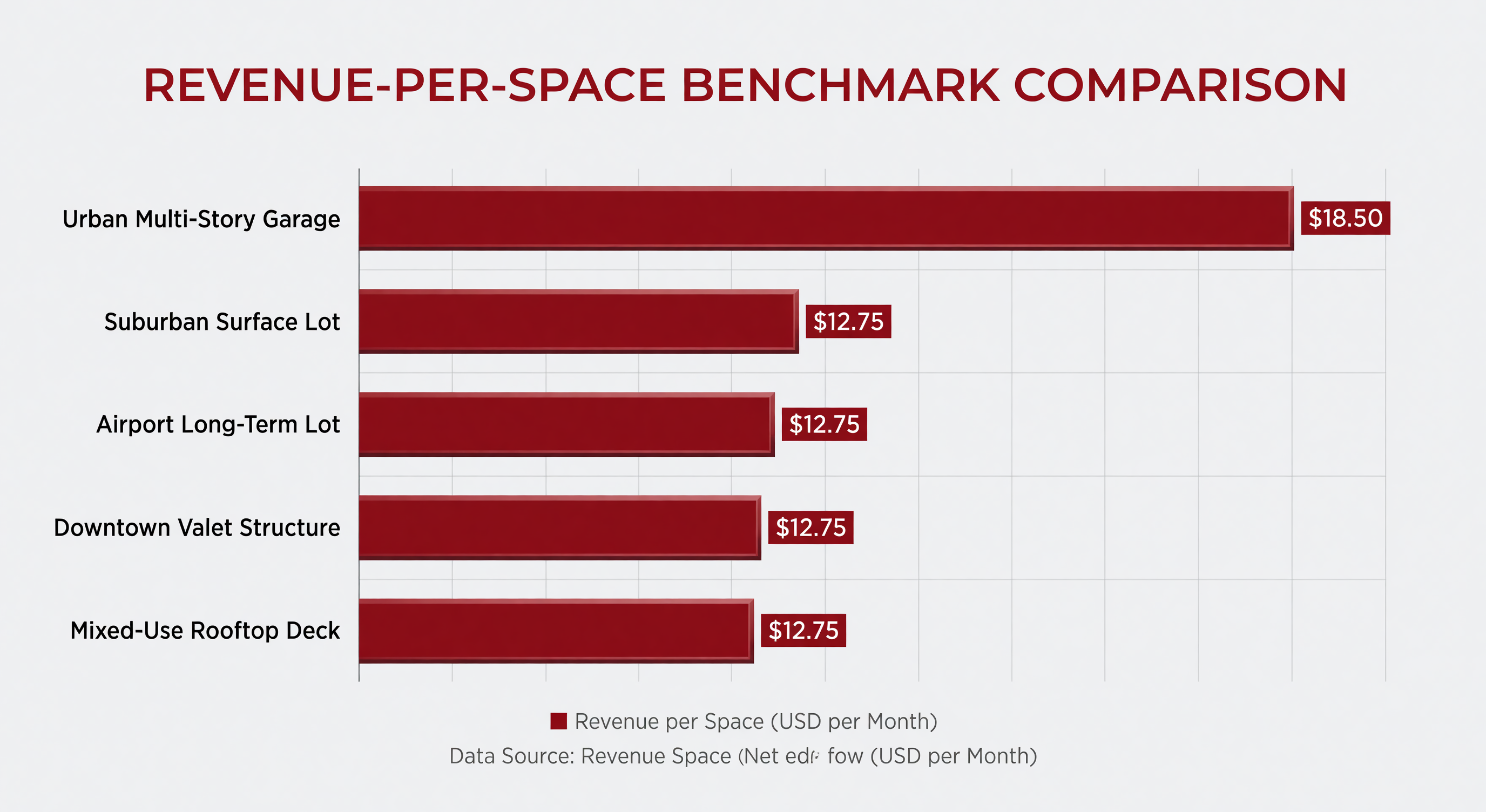
Revenue per available space (RevPAS) is the closest thing the parking industry has to a universal performance metric. It normalizes for facility size, allows apples-to-apples comparison across markets, and connects directly to asset valuation. Yet most operators can’t tell you their RevPAS without doing math they’ve never done before. That’s a problem — because the gap between average facilities and top performers is 2–3x, and most of it isn’t explained by location.
Why Revenue Per Space Is the Core Metric
Total revenue is a vanity number without context. A 1,200-space garage generating $3.2 million annually is significantly underperforming if the benchmarks for its facility type and market suggest it should generate $5.5–$7.2 million. A 200-space surface lot generating $380,000 annually may be doing well or terribly depending on where it sits.
RevPAS strips away size as a variable. What’s left is a measure of how effectively you’re monetizing each unit of inventory — combining your rate strategy, occupancy performance, and revenue mix into a single comparable number.
For lenders, buyers, and asset managers, RevPAS is also the primary underwriting metric. A facility’s value is roughly a multiple of its net operating income, which flows from RevPAS. Operators who can demonstrate above-benchmark RevPAS with a credible explanation command better financing terms and higher exit multiples.
Benchmark Ranges by Facility Type
Surface Lots
Annual RevPAS range: $500–$2,500
The widest variance of any facility type. Surface lots in suburban markets with low transient demand and no permit program sit at the bottom. Surface lots in urban cores with metered street competition, high turnover, and active monthly programs sit near the top.
Key variables:
- Paving/striping vs. unpaved: Properly striped lots capture 10–20% more revenue through better utilization efficiency
- Enforcement: Unmonitored lots typically run 8–15% no-pay rates; enforced lots drop to 2–5%
- Monthly mix: Surface lots with 40%+ monthly revenue show significantly more stable and higher RevPAS
Low-end benchmark ($500–$900): Secondary-market unmonitored lot, no monthly program, transient-only, cash-heavy payment mix.
High-end benchmark ($2,000–$2,500): Urban surface lot, metered or paid entry, active monthly program, digital payment, 80%+ peak occupancy.
Open-Air Structured Parking (Deck/Open Garage)
Annual RevPAS range: $1,500–$4,000
Open-air garages — multi-level structures without climate control — outperform surface lots primarily through capacity density and visibility. Being a visible, clearly-identifiable parking structure in a high-traffic corridor commands a natural rate and occupancy premium over surface lots on side streets.
Key variables:
- Height: More levels = higher RevPAS up to a point. 4–6 level structures typically optimize best. Very tall structures (8+ levels) can see utilization fall off on upper floors, depressing blended RevPAS.
- Payment system: PARCS-equipped (automated payment at entry/exit) garages outperform manually ticketed ones by 15–30% in RevPAS due to faster throughput and better rate enforcement.
Enclosed Structured Garage (Urban)
Annual RevPAS range: $3,000–$8,000+
This is the flagship category for RevPAS benchmarking. Enclosed structured garages in urban markets — with active rate management, a monthly parker program, and event/demand pricing — represent the performance ceiling for most operators.
At the high end ($6,000–$8,000+/space/year), you’re typically looking at:
- Dense urban location with constrained supply (limited competing inventory within 3 blocks)
- 90%+ monthly permit occupancy with active waitlist
- Daily transient rates of $20–$40 with flexible event pricing
- 70%+ digital payment mix reducing transaction costs
- Revenue recovery program for no-pays
The gap between a $3,000 and a $7,000 RevPAS garage in the same market tier is almost never explained by location alone. Pricing strategy, retention, and operational efficiency account for most of the difference.
Airport Parking
Annual RevPAS range: $4,000–$12,000+
Airport parking is the highest-RevPAS category because of captured demand — travelers need to park, have limited alternatives, and have low price sensitivity relative to the total trip cost.
Variance is driven primarily by:
- On-airport vs. off-airport: On-airport garages command 30–60% premiums over off-airport lots
- Express/premium lanes: Facilities with premium products (guaranteed covered, express exit) generate RevPAS at the top of the range
- Pre-booking penetration: Airports with high online pre-booking rates show better RevPAS through dynamic pricing capture
The $12,000+ outliers are typically on-airport express/covered products at major hub airports.
On-Street Meters and Pay Stations
Annual RevPAS range: $2,000–$6,000
On-street metered spaces typically generate higher RevPAS than off-street surface lots despite lower rates — because turnover is much higher. A metered space priced at $2.50/hour with 10 hours of daily operation and 80% occupancy generates $7,300/year ($2.50 × 8 hours × 365 days). That math assumes well-enforced, reasonably occupied meters.
The wide range reflects enforcement quality more than anything else. Minimally enforced meters see 20–40% non-compliance rates. Cities with consistent enforcement see 5–10% non-compliance and RevPAS in the $4,000–$6,000 range.
Valet Operations
Annual RevPAS range: Highly variable; net RevPAS to facility owner is typically $2,500–$6,000 after valet contractor margin.
Valet shifts the operational burden to a contractor but reduces the owner’s net RevPAS capture because the contractor takes 20–40% of revenue. On the other hand, valet enables 30–50% higher space utilization through tandem and stacked parking. The net math depends on the contract structure and utilization lift.
Market Tier Adjustment
Benchmarks above are blended national figures. Adjust by market tier:
| Market Tier | Examples | Multiplier vs. National Avg |
|---|---|---|
| Tier 1 | NYC, San Francisco, Chicago, Boston, Seattle | 1.5–2.5× |
| Tier 2 | Denver, Nashville, Austin, Atlanta, Portland | 1.0–1.4× |
| Tier 3 | Mid-size metros (100K–500K population) | 0.7–1.0× |
| Tier 4 | Small markets, rural | 0.3–0.7× |
Example: A structured urban garage with a national benchmark of $5,000/space/year should expect $7,500–$12,500 in San Francisco (Tier 1 × 1.5–2.5) and $3,500–$5,000 in a Tier 3 market.
These multipliers are rough guides, not precise adjustments. Local supply constraints matter more than market tier in many cases — a Tier 3 market with no new parking construction in 10 years and strong downtown employment can outperform a Tier 2 market with abundant competing inventory.
What Drives Above-Benchmark Performance
Facilities that consistently outperform their tier and type benchmarks share four characteristics:
1. Active Rate Management
They’re not running last year’s rate card. They’re reviewing rates quarterly, comparing to competitive set, and adjusting monthly permit rates when occupancy signals support it. See the revenue KPI framework for the metrics that should trigger rate reviews.
2. Optimized Monthly/Transient Mix
The right monthly-to-transient ratio depends on facility type. Commuter-heavy garages maximize RevPAS at 55–70% monthly. Event-focused facilities maximize at 20–35% monthly. Operators who’ve found their optimal mix and maintain it through active permit program management generate RevPAS 15–25% above facilities with misaligned mix.
3. Event Revenue Capture
Facilities near event venues, stadiums, or entertainment districts with active event pricing programs generate 10–30% of total annual revenue from event premium pricing. This is disproportionate revenue — a single sold-out event night can generate 15–20× average daily revenue per space. Operators without explicit event pricing capture far less.
4. Payment Mix and Cost Control
High digital payment penetration (70%+ card/mobile) reduces transaction costs by $0.50–$2.00 per transaction vs. cash-heavy operations. On a 300-space garage with 150 daily transient transactions, that’s $27,000–$109,500 in annual cost reduction — which flows directly to net RevPAS.
Calculating Your Own RevPAS and Diagnosing Underperformance
Step 1: Pull total annual revenue (all sources — transient, monthly, event, validation revenue, enforcement revenue).
Step 2: Divide by total available spaces (not just occupied spaces — RevPAS measures yield on total inventory).
Step 3: Compare to the benchmark range for your facility type and market tier above.
Common reasons facilities underperform benchmarks:
- Stale rate card: Rates haven’t been reviewed in 2+ years. Most common cause of underperformance in stable markets.
- Low monthly parker retention: High churn means constantly re-filling at acquisition cost; the compounding RevPAS impact of 8% monthly churn vs. 2% is enormous over 3 years.
- Excessive validation/comp: Validation leakage above 20% of transactions significantly depresses RevPAS. Pull your rate realization % (actual collected rate ÷ posted rate) to quantify this.
- No event pricing: If you’re near event venues and charging standard daily rates on event nights, you’re leaving significant revenue on the table.
- Underinvestment in payment infrastructure: Cash-heavy operations with manual ticketing have structural cost disadvantages that reduce net RevPAS.
Connecting Benchmarks to Pricing Strategy
RevPAS benchmarks are the starting point for pricing decisions, not the end point. Once you know your current RevPAS and where you stand relative to benchmark, the next question is which pricing lever moves it fastest.
For permit-heavy facilities, that analysis typically starts with permit pricing strategy — whether your permit rate structure, tier pricing, and annual adjustment methodology is calibrated to support above-benchmark RevPAS.
Practical Takeaway
Calculate your RevPAS for the last 12 months. Compare it to the benchmark range for your facility type and market tier. If you’re below the midpoint of your benchmark range, you have a diagnosable gap — not a market problem. The four drivers above (rate management, monthly mix, event capture, payment mix) explain most underperformance. Rank which gap is largest and start there.