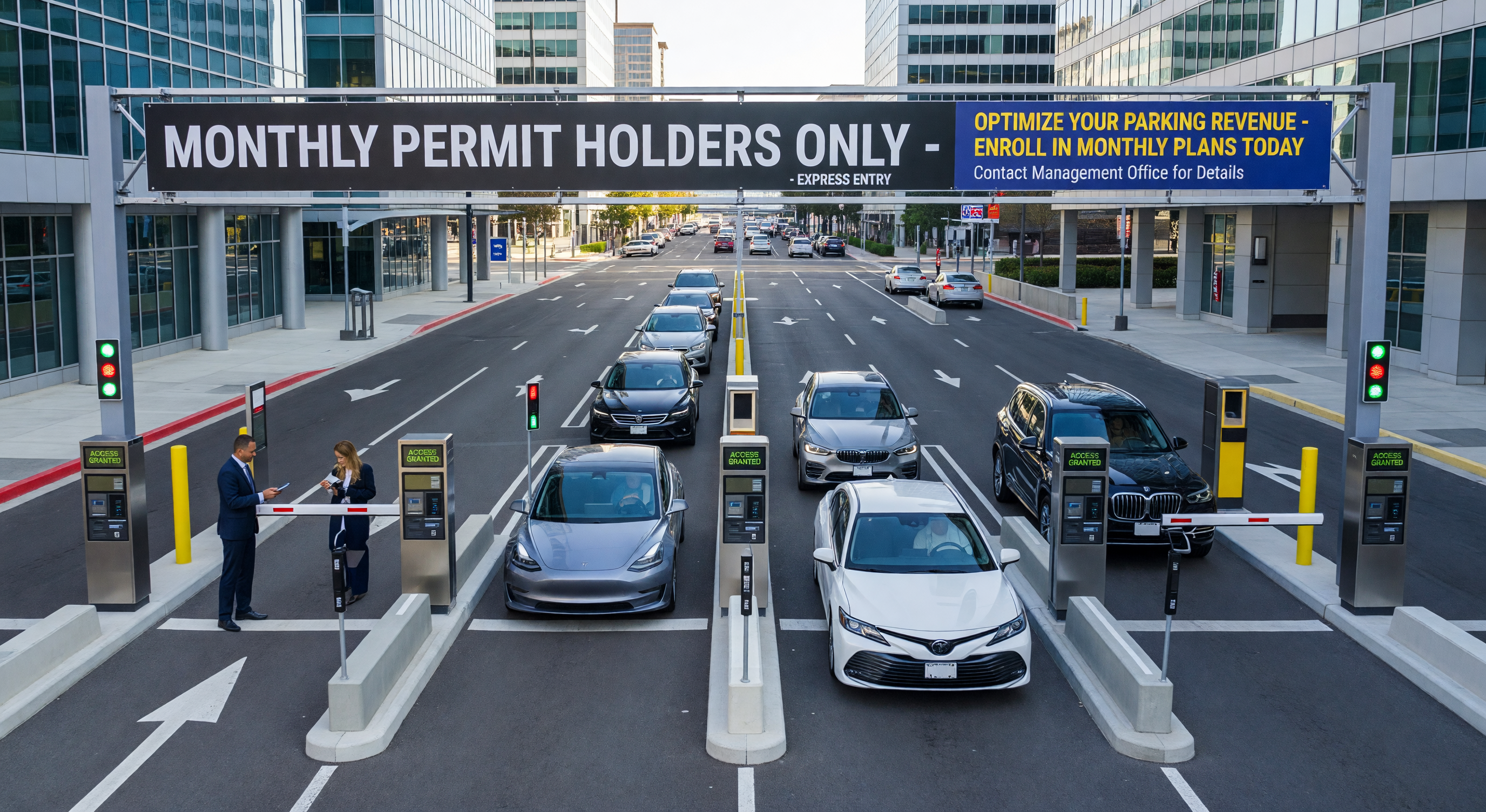
The reflex move when monthly permit revenue stagnates is to raise rates. Sometimes that’s right. More often, the problem is a leaky program — ghost parkers occupying sold permits, poor retention mechanics letting low-churn customers quietly cancel, and untapped upsell inventory sitting empty. This article focuses on the structural fixes that grow monthly revenue without touching the rate card.
Why Monthly Parkers Are the Anchor of a Healthy Operation
Monthly permit revenue has three structural advantages over transient revenue:
Predictability. A facility with 200 monthly parkers at $150/month generates $30,000/month regardless of weather, competing events, or economic softness. That baseline funds payroll, debt service, and maintenance budgeting.
Low transaction cost. Processing a monthly renewal via auto-pay costs a fraction of a cent compared to $0.80–$3.50 per transient transaction. At scale, the cost-per-dollar-of-revenue on monthly revenue is dramatically lower.
Retention economics. A monthly parker who stays for 3 years generates 36x the LTV of a first-time transient parker. The acquisition cost of a new monthly parker — signage, promotion, sales time — is recovered in month 2 or 3. Every retained parker is pure margin.
The downside: monthly revenue requires active program management. Neglect it and you’ll slowly accumulate ghost parkers, miss pricing signals, and watch churn quietly erode your base.
Tracking Actual Utilization vs. Sold Permits
The first thing most operators don’t know: how many of your sold monthly permits are actually being used?
This distinction matters because oversold-but-unused permits represent recoverable revenue. If you’ve sold 220 permits for a 200-space facility but only 170 cars show up on a typical day, you’re leaving 30 spaces empty that you can’t resell — because those permits are technically active.
How to measure it:
- Pull entry/exit data from your access control or parking management system for the same 4-week period
- Count peak-day utilization (typically Tuesday–Thursday, 9am–11am for commuter facilities)
- Calculate your effective utilization rate: actual cars present ÷ sold permits
Industry tracking data suggests 15–25% of monthly permit holders in typical office-adjacent garages use their permit fewer than 10 days per month. Those are ghost parkers.
The overbooking strategy: Once you have utilization data, you can safely oversell permits by a calculated margin — typically 110–120% of physical capacity in facilities where utilization data shows consistent below-capacity patterns. This is standard practice in hotel and airline revenue management. It’s underused in parking.
The key constraint: if you oversell and actual utilization exceeds physical capacity, you’ve got an angry customer problem. Build in a buffer and monitor weekly. A parking management software system that tracks real-time monthly parker utilization is the infrastructure that makes this manageable at scale.
Retention Tactics That Move the Needle
Monthly parker churn rates below 3% are achievable. Most operators run 5–8% monthly churn without realizing it because they don’t track it. Here’s what actually reduces churn:
Auto-Renewal as the Default
Every monthly parking program should default new parkers to auto-renewal. Opt-out, not opt-in. The difference in retention rates between auto-renewal and manual renewal programs is typically 15–25 percentage points — customers who have to actively re-commit each month churn at much higher rates than customers who have to actively cancel.
If your current system requires monthly parkers to renew manually, that single process change is likely your highest-ROI retention improvement.
Tiered Early Renewal Discounts
Offer a modest incentive for parkers who commit to 3-month or 6-month prepayment: 5–7% off the monthly rate. The benefit to you is cash flow certainty and churn elimination for that period. The benefit to the parker is modest savings. This is particularly effective for corporate accounts where the parker doesn’t pay out of pocket and the finance team prefers annual commitments.
Renewal Reminder Sequencing
For non-auto-renewing parkers, a 3-touch reminder sequence outperforms a single “your permit expires” email by roughly 2:1 in renewal rate:
- 30 days out: “Your permit renews next month — make sure your payment info is current.”
- 7 days out: “One week until renewal — confirm your spot is locked in.”
- Day of expiration: “Your permit expired today — renew now to keep your space before it’s offered to the waitlist.”
The waitlist mention in the final message is important: it signals scarcity and urgency in a way that generic renewal reminders don’t.
Waitlist Management as a Revenue Signal
If you don’t have a monthly parker waitlist, you’re probably under-priced or under-marketed.
A well-managed facility in a supply-constrained market should always have a waitlist of 10–30% of total permit capacity. That list tells you three things:
- Demand exists at current price. You can likely raise rates at next renewal cycle without meaningful churn — demand is demonstrably not price-sensitive at current levels.
- You have a conversion pipeline. When a monthly parker cancels, you should be filling that space within days, not weeks. A cold waitlist (prospects who signed up 8 months ago) converts at much lower rates than an actively managed one.
- You can measure price elasticity. If your waitlist is 80 people long and you raise rates 10%, the resulting churn should be minimal. If the waitlist evaporates after the increase, you found the ceiling.
Managing the waitlist actively: Contact prospects at 90-day intervals if no spaces have opened. Ask if they’re still interested. Expired contacts waste your conversion pipeline. A simple CRM or parking management platform handles this automatically.
Reducing Ghost Parkers
Ghost parkers — permit holders with low or no utilization — represent revenue you’ve already sold but can’t recover until the permit cancels. The problem is compounded when ghost parkers renew year after year by auto-pay without anyone noticing.
Identification: Flag any monthly parker who has entered the facility fewer than 8 times in a 30-day period. This threshold varies by facility type (airport parkers may legitimately have low frequency), but for urban commuter garages, fewer than 8 entries in 30 days is a strong ghost-parker signal.
What to do with them:
- Offer a downgrade: a partial-month permit, a “light user” plan at a lower price point, or a pay-as-you-go alternative. Some ghost parkers will self-select out, freeing the space for a full-utilization parker.
- Proactively contact them: “We noticed you haven’t been using your space much — are you still commuting? We have customers on our waitlist who need the space.” Direct but not aggressive.
The goal isn’t to push them out forcefully — it’s to match permit inventory to actual demand. A parker who genuinely needs the occasional spot might be better served (and happier) on a part-time or flex permit if you offer one.
Upsell Programs: Reserved Spaces, Premium Access, and EV Add-Ons
Monthly permit revenue doesn’t have to be flat per parker. Three upsell categories can materially increase per-permit revenue:
Reserved Spaces
Standard monthly permits guarantee access but not a specific space. A reserved space permit — same numbered spot every day — commands a 15–35% premium in most markets. Demand is strongest from:
- Senior executives who value predictability
- Parkers with mobility constraints
- High-turnover facilities where guaranteed availability has real value
Reserved inventory is typically 5–15% of total monthly permit capacity. Pricing it at a premium creates a tiered product without adding operational complexity.
Premium Access Tiers
In multi-level garages, location within the structure has value. Level 1 (closest to elevator/exit) spaces fill first. Tiering your monthly permit pricing by level — with Level 1 at 20–30% premium over upper levels — captures that value explicitly rather than giving it away to whoever signed up first.
EV Charging Add-Ons
EV charging as a monthly add-on is the fastest-growing upsell in parking. Current market pricing for guaranteed charging access runs $40–$90/month above the base permit price in metro markets. If your facility has charging infrastructure, packaging it as an exclusive add-on for monthly parkers (vs. pay-per-use for transient) creates retention value and premium revenue simultaneously.
For deeper coverage of permit pricing strategies across different facility types, including tiered and demand-based models, see the full analysis.
Monthly Parker KPIs to Track
Track these alongside your broader monthly parker KPIs for a complete performance picture:
- Monthly churn rate (target: below 3%)
- Auto-renewal adoption % (target: above 70% of active permits)
- Utilization rate (actual cars ÷ sold permits, target: 75–90%)
- Waitlist length as % of capacity (target: 10–30%)
- Average permit revenue per space (base + upsells)
- Ghost parker % (fewer than 8 entries/month, target: below 10%)
Practical Takeaway
Pick one: if your monthly permit program has no auto-renewal default, set that up first — it’s the single highest-ROI change you can make in an afternoon. If auto-renewal is already in place, pull your last 60 days of entry data and count how many permit holders entered fewer than 8 times. That ghost parker number will tell you whether you have an overbooking opportunity or a retention problem — and both are solvable with the right program mechanics.