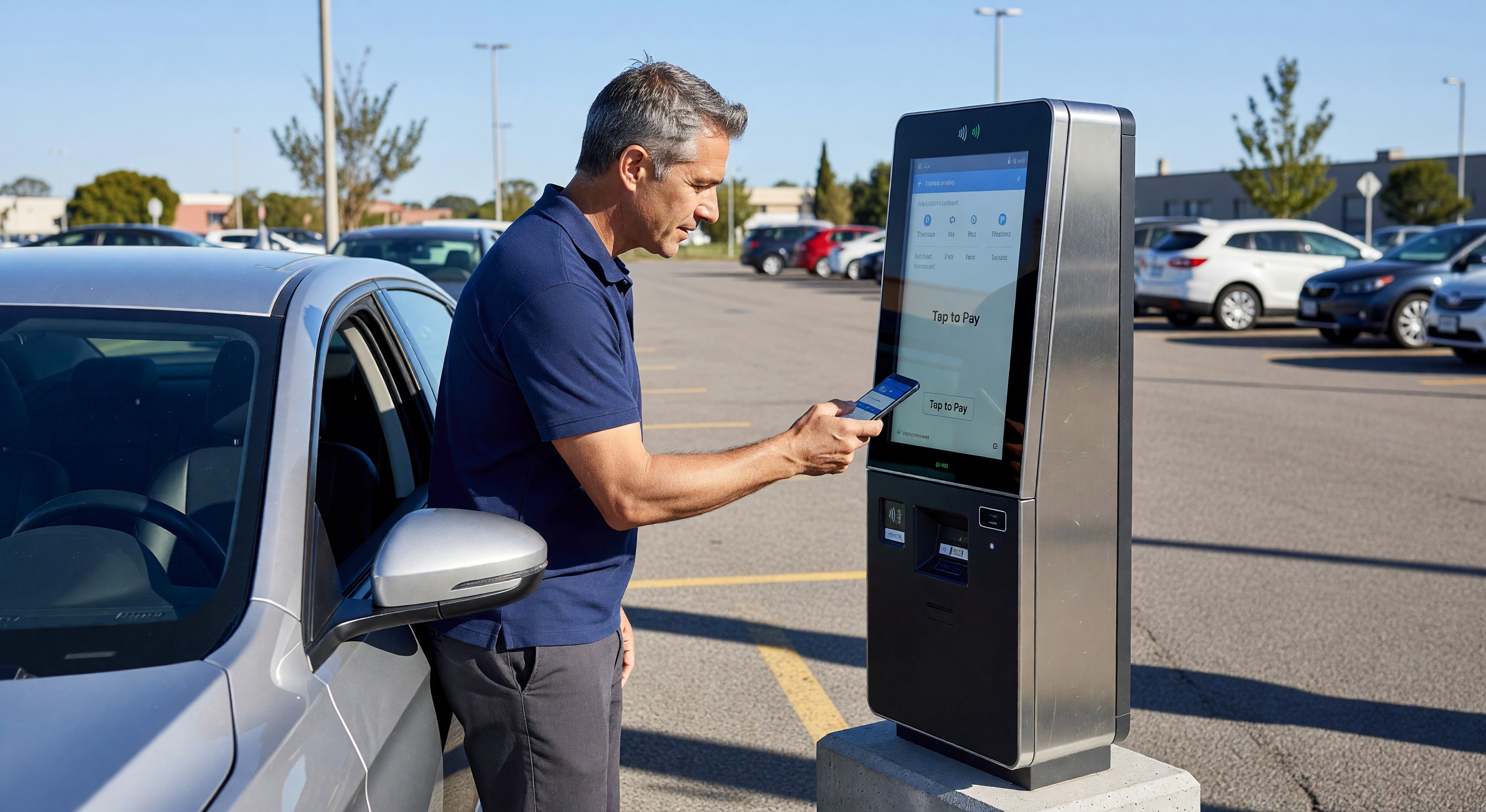
The shift from cash to contactless payment in parking operations has been underway for a decade and accelerated sharply during the pandemic period, when health concerns pushed both operators and customers toward touchless transaction options. By 2024, contactless acceptance — tap-to-pay credit and debit cards, mobile wallets, and app-based payment — has moved from differentiator to baseline expectation in most urban parking markets.
What the industry is still sorting out is the revenue and cost arithmetic. Operators who added contactless capability often accepted it as a cost of modernization without fully modeling how the payment mix shift would affect transaction costs, revenue per space, and operational overhead. In some cases the numbers are favorable; in others, operators have taken on merchant processing costs that exceed the operational savings from reduced cash handling.
A clear-eyed assessment requires separating what contactless payment actually delivers from what its marketing implies.
What Changes When You Accept Contactless Payment
The mechanics of contactless payment — NFC-enabled cards and mobile wallets, QR code-based mobile apps, in-lane card readers — all accomplish the same thing: a parking transaction is completed without the parker handling physical cash and without an attendant processing a payment manually.
What this changes operationally:
Cash handling volume decreases. Each contactless transaction eliminates the cash-handling labor, dual-custody counting, armored car pickups, bank deposit trips, and shrinkage risk associated with the equivalent cash transaction. The cost reduction is real and significant: cash handling typically costs $2–$5 per transaction in total operational overhead when labor, security, and shrinkage are included, versus $0.10–$0.30 for an attended card swipe in a PARCS-integrated environment.
Reconciliation becomes simpler. Card transactions settle to the bank in predictable batches. Daily reconciliation of a card-dominant payment mix requires matching the PARCS transaction file against a single payment processor settlement report. Cash reconciliation requires comparing register totals, shift reports, and bag counts against deposits — a more complex, more labor-intensive, and more fraud-exposed process.
Customer friction changes. Contactless payment eliminates the need for exact change, wait for change to be made, or search for a functioning ATM before parking. This reduces one category of customer friction while potentially introducing others: app registration requirements, mobile data dependency in underground garages, or tap reader malfunctions in cold weather.
Transaction data improves. Card and mobile payments generate transaction-level data with customer identifiers (encrypted) that cash does not. This data supports revenue analytics, pattern recognition for dynamic pricing, and customer program development (loyalty programs, monthly parker migration) that cash-heavy operations cannot pursue.
The Revenue Impact: What the Numbers Actually Show
The most commonly cited revenue impact claim is that contactless payment increases captured revenue by reducing non-pays and short-pays. This is true in some conditions and not others.
For ungated surface lots, the impact is material. Lots that previously relied on pay-and-display meters accepting cash-only saw meaningful captured revenue increases when mobile payment was added. Parkers who arrived without cash — an increasingly common situation as cash carrying rates decline — either found a way to pay (good) or parked without paying (bad). Mobile payment eliminates the “I don’t have change” unpaid parking scenario. Studies of mobile payment adoption in municipal on-street operations have documented captured revenue increases of 10–20% in markets where the switch to multi-modal payment was accompanied by effective enforcement.
For gated facilities with functioning PARCS, the revenue impact is smaller. A gated facility that already captures payment at exit — the gate doesn’t open without payment — doesn’t have a non-pay problem that contactless payment solves. The revenue impact is more modest: some improvement in average transaction value if mobile prepay options drive longer-stay bookings, and some reduction in lost tickets (where parkers pay the lost ticket fee rather than the shorter actual stay) if mobile payment is tied to a time-stamped entry record.
For event parking, mobile prepay has documented revenue impact. Facilities that allow event parkers to pre-purchase at a defined price before the event see reduced price sensitivity at purchase time — a parker who buys at $25 three days before the event cannot compare prices at adjacent garages in real time. Mobile prepay also accelerates ingress, reducing the congestion at entry that causes some event parkers to abandon and park elsewhere.
Transaction Cost Structure
The transaction cost arithmetic of contactless payment varies by payment method and PARCS integration design. Operators should model this before committing to specific technology investments.
Tap-to-pay credit/debit cards processed through a PARCS-integrated payment terminal carry standard interchange rates from the card networks. For parking transactions — typically under $30, often under $15 — interchange rates in the U.S. average approximately 1.5–2.5% of the transaction amount, plus a flat per-transaction fee that varies by processor. On a $10 transaction, the total processing cost might be $0.25–$0.45. Compared to cash handling at $2–$5 per transaction, this is favorable.
Mobile wallet transactions (Apple Pay, Google Pay) process through the same card rails as the underlying card and carry similar interchange economics. The merchant sees essentially the same cost structure as a tap-to-pay card transaction.
Dedicated parking apps (SpotHero, ParkWhiz, and operator-branded apps) have more variable cost structures. Third-party booking platforms take a commission on the booking, typically in the range of 10–25% of the transaction value — substantially higher than direct card processing. Operator-branded apps with direct payment processing carry only the underlying card processing costs plus app development and maintenance overhead.
The implication for operators: accepting bookings through third-party platforms at 15–20% commission on every transaction significantly affects net revenue per space. The revenue visibility and customer acquisition these platforms provide may justify the cost for operators building volume, but high-volume facilities should model the commission cost against the customer acquisition value before making third-party booking a primary revenue channel.
What Hybrid Operations Look Like
Most parking facilities in 2024 operate hybrid payment environments — accepting cash, card, tap, and mobile — rather than fully cashless. The transition to cashless has been slower than some operators anticipated, driven by a combination of equity concerns (access for unbanked populations), customer preference variation, and the operational complexity of managing mixed payment types.
Hybrid operations allow operators to capture the benefits of contactless payment for the growing contactless-preferring majority while not excluding cash-paying customers. The operational cost of maintaining cash capability — even at reduced volume — is not trivial: the equipment must still be maintained, cash handling procedures must still be followed, and the reconciliation process still needs to accommodate cash transactions.
The payment mix trend in urban parking is consistently toward card and mobile, with cash declining each year. In major urban markets, cash as a percentage of parking transactions has fallen below 15% for many structured garage operators. The inflection point where eliminating cash entirely becomes operationally and financially defensible — and where equity concerns can be addressed through alternative means — is approaching for high-volume urban facilities, though it has not arrived uniformly.
Technology Requirements for Full Contactless Capability
Operators building or upgrading toward contactless capability need several integrated components. A broader ROI framework for evaluating these and other parking technology investments is covered in the parking revenue technology ROI guide:
NFC-enabled payment terminals at entry and exit lanes. Older PARCS pay stations without NFC readers must be upgraded or replaced. The hardware upgrade cost varies widely by system, from software-plus-peripheral updates for modern PARCS to full terminal replacement for older systems.
Mobile payment gateway integration. Whether through a white-label mobile payment solution integrated with the PARCS, or through third-party app partnerships, mobile payment requires an API or integration layer connecting the mobile payment system to the PARCS for session validation and gate release.
License plate recognition (optional but high-value). LPR systems that associate entry plate data with a mobile payment session allow frictionless exit — the parker pays on the app, their plate is recognized at exit, and the gate opens without a further action required. This is the highest-friction-reduction configuration and commands premium acceptance rates in customer surveys.
Connectivity in the parking structure. Mobile payment in underground garages or dense urban structures requires cellular connectivity or facility WiFi that reaches the pay station level. Dead zones are a consistent mobile payment barrier that LPR-based frictionless exit partially resolves by allowing payment to occur before entry.
Frequently Asked Questions
Does accepting contactless payment meaningfully increase revenue?
The revenue impact depends heavily on facility type. Ungated surface lots with enforced pay-and-display meters see material revenue increases from mobile payment — 10–20% or more in some documented cases — because mobile eliminates the “no cash” non-pay scenario. Gated facilities with functioning PARCS see smaller revenue impacts, with the primary benefits in transaction cost reduction and customer experience rather than captured revenue.
What are the typical merchant processing fees for contactless parking payments?
Standard interchange for small-ticket card transactions runs approximately 1.5–2.5% of the transaction amount plus a per-transaction fee. On a $10 transaction the total processing cost is roughly $0.25–$0.45. Third-party booking platforms carry higher effective costs — typically 10–25% commission — that should be carefully modeled against the customer acquisition benefit.
Should parking operators go fully cashless?
For high-volume urban structured garages with diverse transportation alternatives available to unbanked customers, the operational case for cashless is becoming strong as cash transactions fall below 15% of volume. For surface lots, municipal operations, and facilities serving lower-income populations, equity considerations and regulatory constraints in some jurisdictions limit the feasibility of fully cashless operations. A hybrid approach remains appropriate for most facilities.
What is LPR-based frictionless exit and how does it affect revenue?
License plate recognition frictionless exit allows a parker to pay via mobile app, have their plate recognized at exit, and leave without interacting with a pay station. It eliminates the exit gate as a congestion point and reduces customer friction at the end of the parking experience. The revenue impact is indirect — improved customer experience supports retention and repeat visits — but facilities with event demand report reduced abandonment at exit when frictionless exit is available.
How does mobile payment data improve revenue management?
Card and mobile payment transactions generate session-level data with timestamps, duration, payment method, and amount that cash doesn’t produce. This data supports time-of-day and day-of-week occupancy analysis (essential for dynamic pricing implementation), demand forecasting, and customer lifetime value analysis for monthly parker program development. Cash-heavy operations work from summary totals; contactless-heavy operations work from transaction-level datasets.
Are there regulatory requirements affecting cashless transitions in parking?
Several U.S. cities and states have enacted legislation or regulations limiting the ability of businesses to refuse cash payment, citing financial inclusion concerns. Operators considering cashless transitions should review applicable state and local laws in their operating markets before eliminating cash acceptance.
Further Reading from Authoritative Sources
- Federal Highway Administration — Parking Payment Technology and Operations — FHWA’s transportation performance management resources include technology assessments covering payment modernization, cashless transition impacts, and operational efficiency metrics applicable to parking facility management.
- International Parking and Mobility Institute — Payment Technology Resources — the IPMI’s resource library covers payment technology adoption, transaction cost benchmarking, and mobile payment implementation guidance developed from operator survey data and case studies.