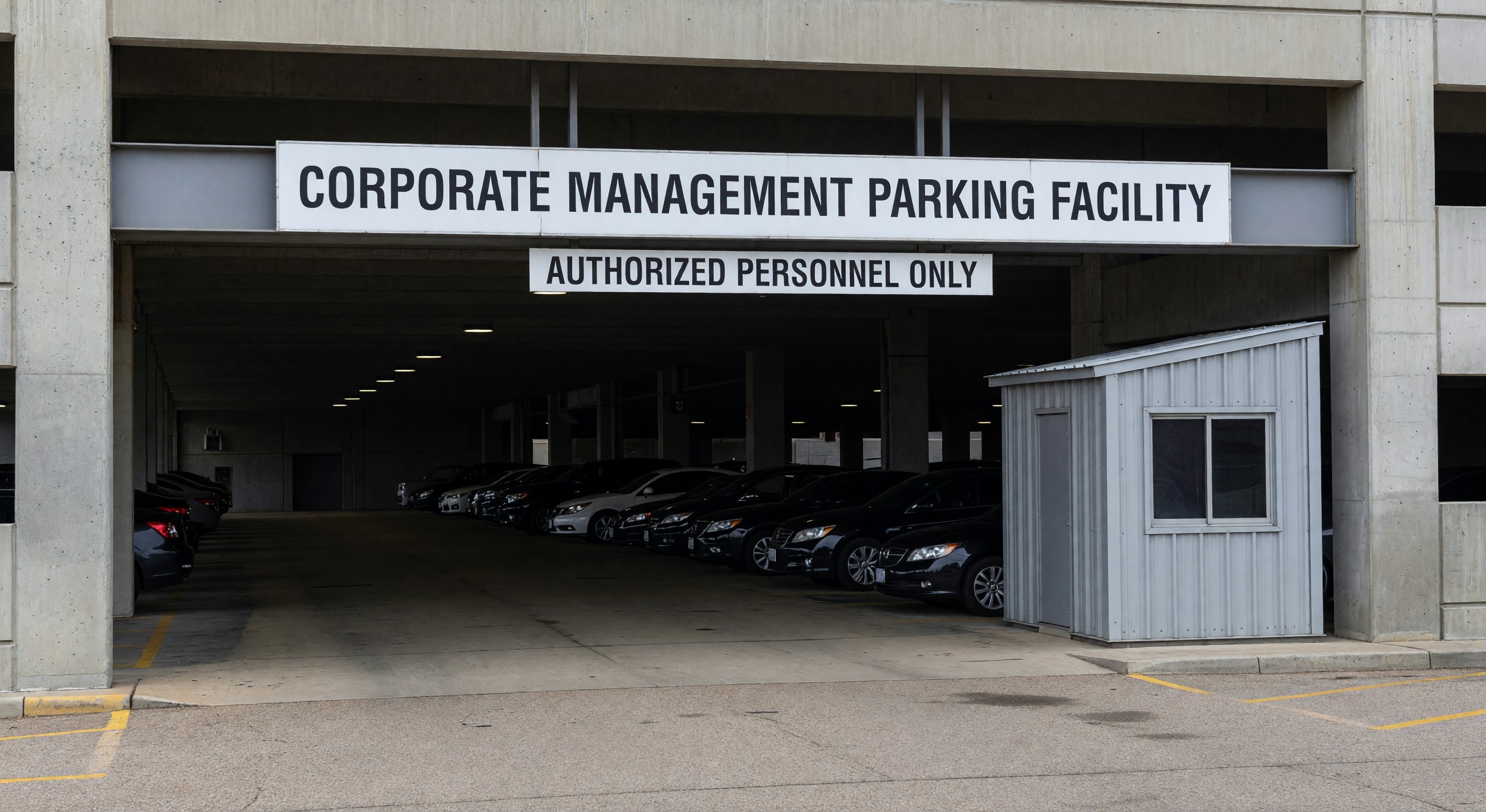
The relationship between a parking facility owner and a parking management company involves a fundamental question of risk allocation. The performance benchmarks relevant to evaluating either party’s performance under any contract structure are covered in the 2025 parking revenue benchmarks: who bears the revenue risk when parking demand falls short of projections, and who captures the upside when demand exceeds them?
The answer varies by contract structure, and the structure determines the financial incentives, oversight requirements, and practical experience of both parties throughout the contract term. Property owners who select a management structure without fully modeling the risk-return implications often find, years into a contract, that the structure they chose has worked against their interests in ways that were foreseeable.
Three primary contract models are used in the parking management industry. Each has variants, and hybrid arrangements are common. Understanding the financial mechanics of each helps property owners negotiate appropriate structures and helps parking operators explain the implications of structure choice to their clients.
Model 1: Management Fee Agreement
In a management fee arrangement, the parking operator manages the facility on behalf of the owner, collects all revenue, pays all operating expenses from that revenue, and remits the net balance to the owner after deducting a management fee. Revenue risk rests with the property owner.
How the financials work:
A facility generating $800,000 in annual gross revenue with $320,000 in operating expenses produces $480,000 in net operating income. Under a management fee contract:
- Gross revenue: $800,000 (owner’s revenue)
- Operating expenses: $320,000 (paid from revenue)
- Management fee: $40,000 (5% of gross, a common fee basis, paid to operator)
- Net to owner: $440,000
If revenue falls to $650,000:
- Management fee: $32,500 (5% × $650,000 — the fee decreases with revenue, not at the same rate as operating expenses)
- Net to owner: $650,000 - $320,000 - $32,500 = $297,500
The owner absorbs the full revenue decline. The management fee declines proportionally, reducing (but not eliminating) the operator’s exposure to revenue downturns. Operating expenses are relatively fixed, which means the owner’s net income is highly sensitive to revenue fluctuations.
What drives management fee level:
Management fees are typically expressed as a percentage of gross revenue (3–7% is a common range for mid-size facilities) or as a flat monthly fee. Some agreements use a combination: a base fee plus a percentage of revenue above a threshold, creating an incentive structure that rewards revenue performance.
Fee-only contracts with no performance bonus can create weak incentive alignment — the operator captures revenue from managing the facility but has limited financial stake in optimizing revenue performance. Adding an incentive fee tied to net operating income above a budget threshold improves alignment.
Open-book accounting is essential in management fee arrangements. The property owner should have full transparency to revenue records, expense records, and the management fee calculation. Management agreements without open-book provisions leave the owner unable to verify that the financial reporting is accurate. Audited financial statements, or at minimum the right to audit, should be a contract requirement.
Model 2: Net Lease (Revenue Guarantee)
In a net lease or revenue guarantee arrangement, the parking operator takes the facility under a lease — paying the property owner a guaranteed amount regardless of actual revenue performance. The operator collects all revenue, pays all operating expenses from that revenue, and keeps whatever remains after paying the guaranteed lease amount. Revenue upside belongs to the operator; revenue downside risk is absorbed by the operator.
How the financials work:
A facility with $800,000 in projected annual gross revenue and $320,000 in operating expenses projects $480,000 in net operating income. Under a net lease:
- Guaranteed rent to owner: $360,000/year (owner’s certainty)
- Operator revenue: $800,000
- Operator expenses (operating costs + rent): $320,000 + $360,000 = $680,000
- Operator margin: $120,000 (if projections hold)
If revenue is $900,000:
- Operator margin: $900,000 - $320,000 - $360,000 = $220,000 (operator captures all upside)
If revenue is $650,000:
- Operator margin: $650,000 - $320,000 - $360,000 = -$30,000 (operator absorbs the loss)
The operator’s underwrite of the net lease requires a conservative revenue projection — the guaranteed rent is typically set at a level the operator is confident it can cover even in a below-expectation scenario. This means the guaranteed rent in a net lease is typically lower than what a management fee arrangement would net the owner in an expected-case scenario.
When net leases make sense for property owners:
Owners who value revenue certainty — stable cash flow for debt service, simplified reporting, no management oversight responsibility — often prefer net leases even though they sacrifice expected-case upside. Owners who lack the internal resources to oversee a management company may also prefer the simplicity of a net lease.
When net leases are problematic:
Long-term net leases (10–15+ years) can trap owners at below-market rents if the parking market improves significantly during the term. An owner who signed a net lease in 2015 at $300,000/year in a market where equivalent parking now generates $600,000/year in net operating income has given away a decade of revenue upside. Rent escalation clauses — annual CPI adjustments, rent step-ups every 3–5 years, or percentage rent tiers above a revenue threshold — are essential protections against this outcome.
Model 3: Hybrid and Incentive-Based Arrangements
Hybrid arrangements attempt to achieve the revenue certainty of a net lease structure with the upside participation of a management fee structure. The most common form is a base guarantee plus participation above a threshold:
Example structure:
- Base guaranteed payment to owner: $280,000/year (floor income, similar to net lease)
- Participation: 50% of gross revenue above $700,000 threshold
- At $800,000 actual revenue: $280,000 + (($800,000 - $700,000) × 50%) = $280,000 + $50,000 = $330,000 to owner
- At $900,000 actual revenue: $280,000 + (($900,000 - $700,000) × 50%) = $280,000 + $100,000 = $380,000 to owner
This structure gives the owner downside protection (guaranteed floor), incentive alignment with the operator (operator keeps more margin if they grow revenue), and participation in upside (owner gets half of revenue above threshold).
Performance-based management fee variants:
A management fee structure with an incentive layer uses a base management fee plus a performance bonus. A typical structure:
- Base fee: 4% of gross revenue
- Incentive fee: 15% of net operating income above the prior-year NOI or an agreed budget threshold
This creates a direct financial stake for the operator in revenue growth and cost management. Operators who generate NOI above the threshold earn more; operators who underperform relative to budget earn only the base fee.
What Contract Terms to Negotiate
Regardless of structure, several contract provisions determine the quality of the owner’s protection:
Termination rights for cause and convenience. The owner should have the right to terminate for material breach by the operator (failure to remit funds, fraudulent reporting, gross negligence) and, ideally, for convenience with appropriate notice. Long-term management contracts without termination rights leave the owner locked in regardless of operator performance quality.
Audit rights. Management fee contracts must include the right to audit the operator’s revenue records and expense documentation. Net lease contracts should include the right to verify that the reported revenue basis for any participation calculations is accurate.
Capital expenditure responsibility. Who pays for PARCS system replacements, structural repairs, elevator maintenance, and major equipment? The contract should define the capital expenditure threshold below which the operator pays from operating budget versus above which the owner is responsible for capital. Ambiguous capital responsibility provisions are a frequent source of disputes.
Rate-setting authority. Who has final authority to set parking rates? In a management fee arrangement where the owner bears revenue risk, the owner typically retains rate-setting authority with the operator having input. In a net lease, the operator typically controls rates as the revenue-risk bearing party. Hybrid structures often specify rate-setting consultation and notification requirements.
Reporting standards. Monthly financial reporting, quarterly performance reviews, and annual audited statements should be defined in the contract. Operators who can deliver financial reporting in opaque, non-comparable formats create oversight gaps. Specify the reporting format, the due date relative to period end, and the accounting basis.
Choosing the Right Structure
The structure that works best depends primarily on the owner’s risk tolerance, oversight capacity, and financial objectives:
| Factor | Favors Management Fee | Favors Net Lease |
|---|---|---|
| Revenue risk tolerance | High | Low |
| Internal oversight capacity | Strong | Limited |
| Expectation of revenue upside | Yes | No |
| Need for cash flow certainty | No | Yes |
| Asset type | High-performing facility | Uncertain market |
For facilities in high-demand markets where revenue is likely to perform well, management fee arrangements typically produce better owner economics. For facilities in uncertain or transitioning markets, or for owners who lack the time or expertise to oversee a management operation, a net lease with appropriate escalation and participation provisions may be the better fit.
Frequently Asked Questions
What is the difference between a management fee and a net lease for parking?
In a management fee arrangement, the property owner retains revenue risk — actual revenue flows through to the owner, and the operator takes a fee for services. In a net lease, the operator takes revenue risk — the operator guarantees a fixed payment to the owner and keeps whatever revenue exceeds the guarantee plus operating costs.
How are management fees typically calculated in parking contracts?
Management fees are most commonly expressed as a percentage of gross revenue (typically 3–7% for mid-size facilities) or as a flat monthly dollar amount. Performance-based structures add an incentive fee tied to net operating income above a baseline. Fee structure and level should be benchmarked against comparable facilities in the market.
What is an incentive fee in a parking management contract?
An incentive fee is additional compensation paid to the parking operator when financial performance exceeds agreed thresholds. Typically structured as a percentage of net operating income above a budget target or prior-year baseline. Incentive fees improve alignment between operator and owner by giving the operator a financial stake in revenue growth and cost efficiency.
Can a parking owner terminate a management contract early?
This depends on the contract terms. Management contracts typically include termination rights for material breach by the operator. Termination for convenience — ending the contract without cause — requires a contractual right to do so, often with a notice period and possibly a payment to the operator. Owners negotiating management contracts should insist on a defined termination-for-convenience right.
How should rate-setting authority be structured in a management contract?
In management fee contracts where the owner bears revenue risk, the owner should have final rate-setting authority — the operator recommends but the owner approves. Operators who want authority to move rates dynamically without owner approval on every change can be accommodated through rate-setting policies that establish approved ranges and require notification rather than approval for changes within the range.
What happens to the parking operator’s fee if the facility has a poor revenue month?
In percentage-of-gross management fee arrangements, the fee decreases proportionally with revenue — the operator’s fee is lower in bad months, providing some alignment. However, operating expenses are relatively fixed, so the owner’s net revenue is more sensitive to poor months than the operator’s fee. This asymmetry is the primary critique of simple management fee structures and is the motivation for incentive fee add-ons that give operators a stake in exceptional performance.
Further Reading from Authoritative Sources
- International Parking and Mobility Institute — Parking Asset Management — IPMI provides resource guides on parking contract structures, management agreement frameworks, and performance management for property owners and operators navigating management structure decisions.
- Transportation Research Board — Parking Concessions and Public-Private Partnerships — TRB research covers public-sector parking contract models including concession structures, revenue-sharing arrangements, and performance monitoring frameworks applicable to both public and private facility contexts.