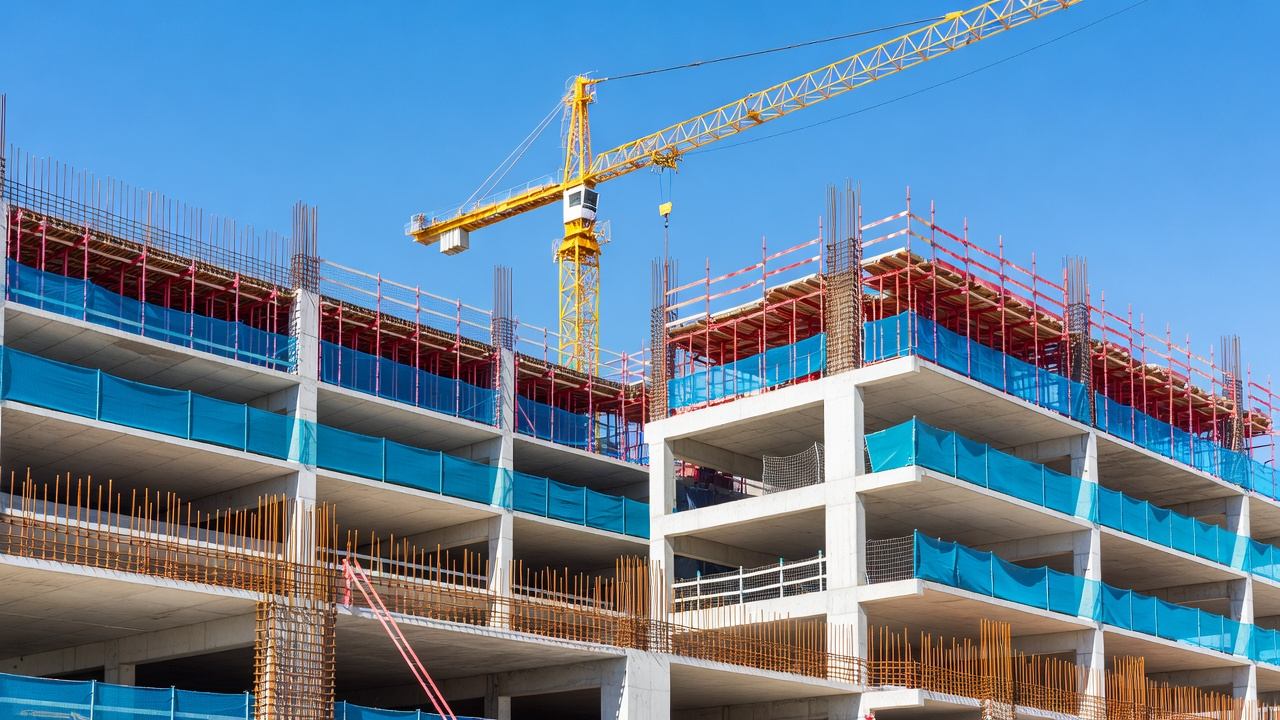
Published 2026 figures put above-grade structured parking in the range of $20,000 to $48,000 per space, depending on the source and the assumptions behind it, with below-grade construction running from roughly $45,000 to well past $100,000 per space. The spread within each range is wider than the difference between many operators’ entire pro formas.
WGI’s cost reporting has attributed recent median increases to labour shortages, rising tariffs, and evolving building code requirements — three drivers that behave differently from one another and none of which resolves quickly.
The number that matters operationally is not the construction cost. It is what that cost obliges each space to earn.
Converting cost per space into required revenue per space
The arithmetic is simple enough to do on one page, and doing it explicitly is more useful than any benchmark table, because it forces the assumptions into the open.
Start with the all-in cost per space — construction plus soft costs, land, and financing, not the construction figure alone. Apply the capital structure: the portion financed carries debt service; the portion of equity carries a return requirement. Add annual operating cost per space. The sum is the required gross revenue per space per year before the project earns anything.
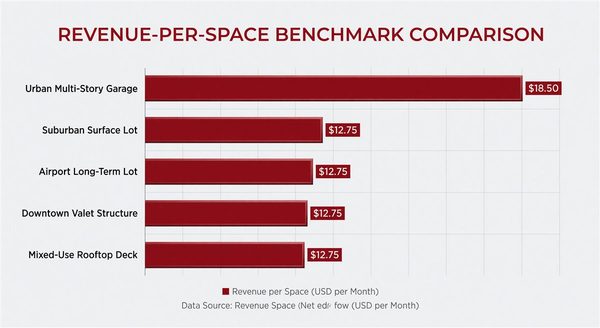
Work an illustrative case at $35,000 per space, sitting mid-range for above-grade construction in 2026. At a 30-year amortisation, that space has to service its share of debt every year for three decades, plus operating expense, plus whatever return the equity was promised. Whether the resulting number is $2,500 or $4,500 a year depends entirely on the interest rate, the equity share, the required return, and the operating cost — which is exactly why importing someone else’s revenue-per-space benchmark is unsafe.
Two structures with identical construction costs and different capital stacks have materially different revenue requirements. A benchmark drawn from a market with cheaper debt is not transferable.
What the cost range means for the assumptions
The range is not noise, and picking the middle is not conservative. Position within it is driven by structural system, site conditions, height, seismic and wind requirements, façade treatment, and local labour markets. A project should be modelled against a range specific to its own parameters, and the pro forma should be tested at the top of that range rather than the middle. Costs have been moving up, not down.
Tariff exposure is a schedule risk, not only a price risk. Where tariffs are cited as a cost driver, the exposure is concentrated in specific materials rather than spread across the build. A project that has not identified which line items carry it cannot hedge it, and the same exposure can extend schedule as well as price.
Code changes are permanent. Labour and material pricing cycles. Evolving code requirements do not revert, and they raise the cost floor for every subsequent project.
Below-grade construction should not be assumed comparable. At $45,000 to $115,000 per space, below-grade parking often cannot be justified on parking revenue at all, and is built because the site has no alternative. If the model shows below-grade spaces returning like above-grade ones, the model is wrong.
Where the revenue assumption usually breaks
Having set the required revenue per space, the second half of the exercise is asking whether the market can deliver it. Three failure patterns recur:
Occupancy assumed at design capacity. A structure is sized for peak demand and modelled at near-peak occupancy. Actual utilisation across all hours is much lower, and revenue per space is earned across all hours.
Rate escalation assumed at inflation. Parking rates in most markets are constrained by competing supply and, on municipal assets, by political tolerance. A model escalating rates at general inflation for thirty years is asserting something about the market that has not been tested.
Transient and contract revenue blended. They have different yields, different volatility, and different sensitivity to remote work. A blended average conceals which one the project actually depends on.
The practical discipline
Before construction cost is even discussed, write down the revenue per space the market can plausibly support at realistic occupancy, then invert the calculation to find the construction cost that supports. That number is the budget ceiling.
Projects that run the arithmetic in the other direction — establish a construction cost, then derive the revenue needed and assume the market will provide it — are how structures end up requiring rates the market will not pay. In a cost environment where the drivers are labour scarcity, tariffs, and a rising code floor, the ceiling is the number worth knowing first.