Benchmarks without context are noise. A RevPAS figure that looks strong in a secondary market may be mediocre in a dense urban core, and an occupancy rate that seems healthy at a suburban surface lot is underperformance in a downtown structured garage. The value of benchmarks is not comparison against a universal standard — it is comparison against the relevant peer group for the facility type, market, and operator profile in question.
This guide provides updated parking revenue benchmarks for 2025, organized by facility type and market tier, with context for how to apply them usefully and what the data actually measures.
How These Benchmarks Are Derived
Benchmarks in parking are not produced from a single authoritative dataset. The industry lacks the centralized transaction reporting that hotel and retail sectors use for RevPAR and comp-set analysis. What exists is a combination of:
- IPMI membership surveys: The International Parking and Mobility Institute surveys its operator members periodically on financial performance metrics. The survey data represents a self-selected sample of IPMI members who respond, which tends to over-represent larger, more institutionally managed operations.
- Third-party management company data: Regional and national parking operators aggregate portfolio data from their managed facilities, which provides a more operationally representative sample than IPMI surveys but is not publicly shared at the portfolio level.
- Municipal parking authority reports: Public parking authorities produce audited financial statements that are public record in most jurisdictions. These represent a specific operator profile — municipal and quasi-public — that differs from private operators.
- Transaction-level analysis from PARCS vendors: Parking system vendors aggregate anonymized transaction data from their installed base, producing utilization and rate benchmarks by market. This is the most granular publicly available dataset in some regions.
The benchmarks below reflect composite estimates from these sources, adjusted to 2025 conditions.
Revenue Per Available Space (RevPAS) Benchmarks
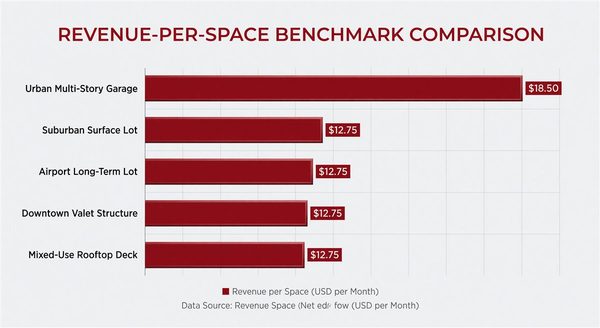
RevPAS — total annual revenue divided by total available spaces — is the primary comparability metric. It normalizes for facility size and allows apples-to-apples comparison across different operations.
Surface lots (non-event):
- Low-demand secondary market: $500–$1,400/space/year
- Moderate-demand suburban market: $1,400–$2,500/space/year
- High-demand urban market: $2,500–$4,500/space/year
Open-air structured garage:
- Secondary market: $1,200–$2,800/space/year
- Primary suburban market: $2,800–$4,500/space/year
- Urban core: $4,500–$7,000/space/year
Enclosed structured urban garage:
- Tertiary urban: $3,000–$5,000/space/year
- Primary urban (non-CBD): $5,000–$8,000/space/year
- CBD/downtown dense market: $8,000–$14,000+/space/year
Airport parking:
- Regional/secondary airport: $2,500–$5,000/space/year
- Primary commercial airport (off-airport): $4,000–$8,000/space/year
- Primary commercial airport (on-airport): $6,000–$15,000+/space/year
Event-primary facilities (sports arenas, entertainment districts):
- Typical event-primary surface lot: $3,000–$8,000/space/year (wide range reflects event frequency)
- Structured event garage: $5,000–$12,000/space/year in high-frequency event markets
Note that RevPAS benchmarks have shifted upward from 2022–2023 levels in most markets due to cumulative rate increases across the industry, reflecting the broader inflationary environment in operating costs that operators have partially passed through to rates.
Occupancy Benchmarks by Facility Type
Peak occupancy targets vary by facility type and should be distinguished from average occupancy. A facility running at 92% peak occupancy may average 65% occupancy across all hours — including overnight and early morning periods with minimal activity.
Target peak occupancy bands (monthly parkers + transient combined):
- Surface lot: 75–88%
- Open-air garage: 80–90%
- Structured urban garage: 85–93%
- Airport long-term: 80–90% (daily)
- Event facility: 88–96% (event periods)
Red flags:
- Consistent peak occupancy above 95% is an under-pricing signal in most markets. You can get to 95% occupancy with an artificially low rate — the question is whether you’re leaving per-space revenue on the table.
- Consistent peak occupancy below 65% in an urban structured garage suggests either a pricing problem (rates too high for the demand level) or a marketing/access problem (parkers not finding or choosing the facility).
Payment Mix Benchmarks for 2025
The contactless-to-cash ratio continues to shift. Payment mix benchmarks for 2025 urban structured garages:
- Credit/debit card (swipe + tap): 48–62%
- Contactless card (tap-to-pay only): 18–28%
- Mobile wallet (Apple Pay, Google Pay): 10–20%
- Third-party app (SpotHero, ParkWhiz, operator app): 8–18%
- Cash: 6–15%
- Validation/comp (net zero to operator): 5–12%
Interpretation:
- Cash above 20% in an urban structured garage is a cost signal and may indicate incomplete payment technology deployment or a customer demographic that over-indexes toward cash.
- Third-party app above 20% of transactions warrants a channel cost review. At 15–20% commission rates, high third-party booking volume can significantly reduce net revenue per transaction.
- Mobile wallet under 8% in a major market suggests either terminal compatibility issues or a customer experience barrier at payment that should be investigated.
Monthly Parker Revenue Mix Benchmarks
The share of total revenue from monthly permits versus transient parking is a significant variable in revenue stability. Monthly permit revenue is predictable and low-cost to administer; transient revenue is higher-margin per transaction but volatile.
Target monthly-to-transient revenue ratios by facility profile:
- Downtown commuter garage: 50–70% monthly
- Urban mixed-use (office + retail): 35–55% monthly
- Hospital/healthcare: 30–55% monthly (variable by validation program design)
- Airport: 5–20% monthly (primarily transient and short-term)
- Event/entertainment district: 10–25% monthly
- Suburban surface lot (office park): 55–75% monthly
Red flag: A commuter garage with monthly parker revenue below 40% of total likely has monthly program pricing below market, inadequate marketing of monthly permits, or high monthly churn. See the monthly parker revenue optimization guide for the diagnostic approach.
Rate Realization Benchmarks
Rate realization — actual collected rate as a percentage of posted rack rate — is the metric that captures the combined effect of validation, discounting, comp practices, and override behavior.
By facility profile:
- Tightly managed urban structured garage (limited validation, controlled comps): 80–88%
- Mixed-use garage with moderate merchant validation: 72–80%
- Garage with large employer validation program: 62–75%
- Hospital parking with broad validation program: 55–70%
- Municipal metered parking with high enforcement: 75–85%
Target to aim for: 78–85% is achievable in most non-healthcare structured garage environments. Below 65% warrants a validation and discount program audit.
Cost Per Transaction Benchmarks
Operating cost per parking transaction reflects how efficiently the facility converts activity into revenue, net of operating overhead.
By facility type and staffing model:
- Fully automated unmanned lot/garage: $0.25–$0.80/transaction
- Partially staffed garage (cashier at exit only): $0.90–$2.00/transaction
- Full-staffed garage with attendant and cashier: $2.50–$4.50/transaction
- Valet-only facility: $5.00–$10.00/transaction
Note: Cost per transaction benchmarks have risen from pre-2022 levels driven by minimum wage increases in most major markets. Facilities relying on labor-intensive models have seen cost per transaction increase 25–40% since 2020 in labor-cost-sensitive markets.
What to Do With a Benchmark Gap
Finding that your facility is below benchmark on a key metric is the beginning of the analysis, not the conclusion. The common benchmarking mistake is treating a below-benchmark number as a target to meet without investigating why the gap exists.
A facility below benchmark on RevPAS may be below because of:
- Rate setting below market (fixable: rate review using the rate-setting methodology)
- Chronic underoccupancy (requires demand diagnosis — is the rate too high for the actual demand level, or is there a marketing/access problem?)
- High validation and comp rates (fixable: validation program audit)
- Structural mix problem (event-dependent facility in a market with fewer events than average — not fully fixable by management, but informs the benchmarking comparison)
A below-benchmark metric is a hypothesis generator, not an answer. For the diagnostic steps that follow a benchmarking gap — including how to audit for revenue leakage — see the parking revenue audit guide.
Frequently Asked Questions
How often should parking operators update their benchmark comparisons?
Annually is the minimum. Market conditions shift: new competitors, transportation infrastructure changes, employer relocations, and remote work trends all affect demand in ways that can move your relevant benchmark range. Some operators update quarterly for key metrics like RevPAS and payment mix, particularly in markets experiencing significant competition or development activity.
Are airport parking benchmarks comparable to other parking types?
Airport parking operates in a structurally different market — customers have no meaningful alternative to the airport’s catchment area for ground access, which produces higher price inelasticity. Airport RevPAS benchmarks are not a useful comparison for non-airport facilities and should not be used as targets for urban commercial parking. The relevant comparison for airport parking is against other airports of similar size and traffic.
Why do CBD parking benchmarks vary so widely ($8,000–$14,000+ per space)?
The range reflects significant market-level variation in daily rates, monthly parker pricing, and transient demand density. Manhattan, San Francisco, and Boston parking command rates several multiples of comparable structured garages in secondary urban markets. Within a market, the range reflects occupancy differences — a garage at 90% average occupancy will generate substantially higher RevPAS than one at 65% at the same rack rate.
Can a surface lot ever achieve structured garage RevPAS levels?
In very high-demand urban markets where land is scarce and the surface lot commands premium rates for convenience or location, yes — some surface lots in CBD environments generate RevPAS comparable to structured garages. This is uncommon. Surface lots typically trade at lower RevPAS than structured parking in the same geography because of their lower capacity per acre and the perceived lower amenity (weather exposure, security perception).
How do I find the right peer group for benchmarking my facility?
The most relevant peer group is defined by: geography (same or similar market), facility type (structured/surface, gated/ungated), primary customer segment (commuter, retail, medical, event), and operation model (owner-operated vs. managed). IPMI member programs and regional parking associations sometimes facilitate peer group comparisons among members on a blind basis. Third-party parking consultants maintain proprietary benchmark databases accessible through consulting engagements.
Are the 2025 benchmarks significantly different from pre-pandemic baselines?
Yes, in two directions. RevPAS benchmarks in the highest-demand markets are higher than 2019 in absolute dollar terms, reflecting cumulative rate increases and robust transient demand recovery. In commuter-dominant markets, monthly parker RevPAS remains below 2019 levels due to hybrid work adoption reducing five-day commuter parking demand. The split between markets is significant and means pre-2020 benchmarks should be applied cautiously.
Further Reading from Authoritative Sources
- International Parking and Mobility Institute — Annual Industry Survey Data — IPMI’s annual state of the parking industry survey provides the most broadly representative publicly available dataset on operator financial performance metrics, including RevPAS, occupancy, and payment mix data from IPMI member facilities.
- Transportation Research Board — Parking Data and Research — TRB’s Transportation Research Record and related publications include peer-reviewed research on parking demand, pricing, and revenue performance across urban and suburban markets providing academic rigor to complement industry survey data.